Bahodir Saidov formulates the modern competition rules of Turon.
Meaning of the name
In the ancient languages of the region — Arabic, Persian, Turkic and Sanskrit — the root “Tur, Tura” meant skilful, strong, fearless (the Avesta and other sources). That is why the modern sport was named Turon: its athletes need agility, strength and firm moral qualities.
History of Turon01 · Newsroom
Federation chronicle
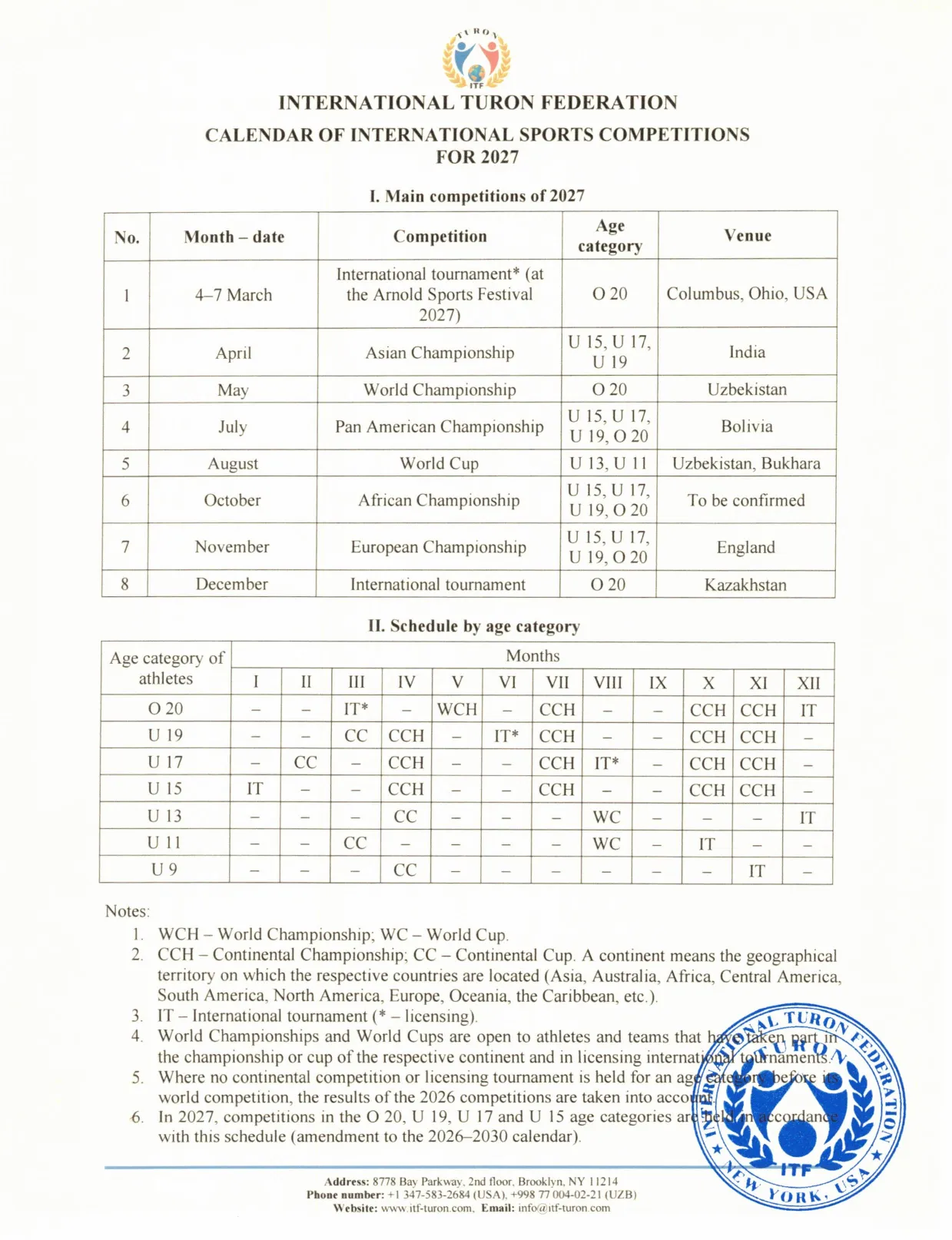
ITF approves the 2027 competition calendar
Eight main competitions on four continents — from the Arnold Sports Festival in Columbus in March to an international tournament in Kazakhstan in December.
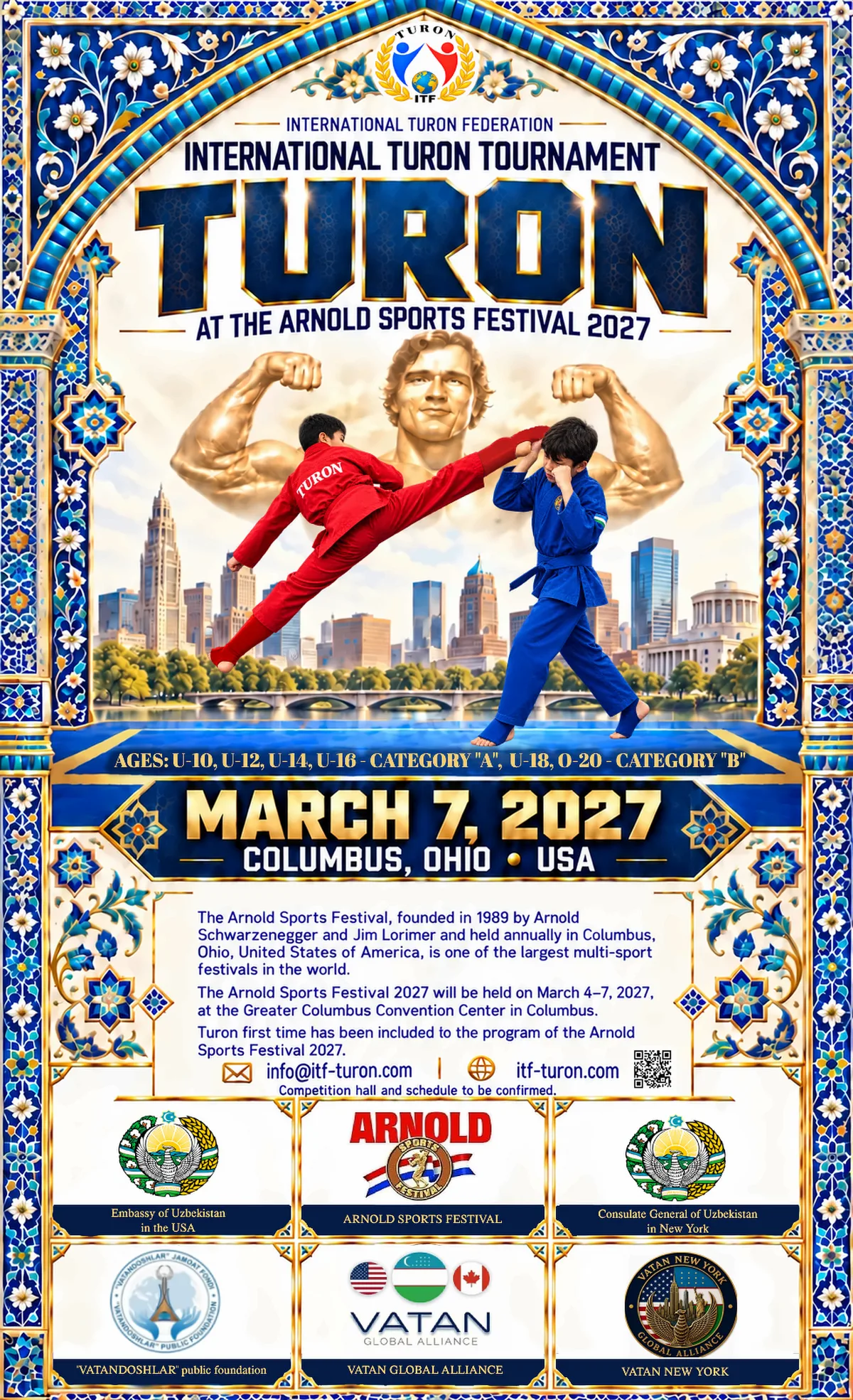
Turon joins the Arnold Sports Festival for the first time
The International Turon Tournament will be held on 7 March 2027 in Columbus, Ohio, as part of one of the largest multi-sport festivals in the world.
From Uzbekistan to the Americas: building the Pan-American future of Turon
Turon’s Uzbek heritage is reaching athletes, coaches and organizations across Venezuela and the Americas. The goal now is a lasting Pan-American pathway.
Turon joins the ranks of the Bolivian Army
The Bolivian Turon Federation has signed a cooperation agreement with the country’s Army. Service members have begun Turon training at the Army Martial Arts School.
ITA free webinar on sports supplements
28 September, 17:00. Recommended for all coaches, referees and athletes on the instruction of the ITF President.
ITF and Alfraganus University sign memorandum in New York
The agreement opens a bachelor’s degree programme in Turon from the 2027/2028 academic year, establishing the academic foundation for training coaches and referees.
Bolivian federation signs agreement with El Alto Public University
The Bolivian Turon Federation has signed an institutional cooperation agreement with the Universidad Pública de El Alto. The aim is to develop Turon as a self-defence discipline within the university's physical education and sport programme. The document was signed by federation president César Castro Claure.
Membership network reaches 16 national federations
The federations of Bolivia, Indonesia, India, Uruguay and Peru have completed registration. Turon is now represented on four continents.
U-19 official protocols published
Four signed protocols covering free exercise and single combat, boys and girls, have been entered into the federation register.
Turon World Cup 2026 concludes in Tashkent
Held at the JAR Sports Complex from 1 to 5 June, the competition crowned medallists across the U-15, U-17, U-19 and senior categories.
Ministry order confirms 541 athletes
The entry list for the World Cup was formalised by order of the Ministry of Preschool and School Education.
National squad for 2026 announced
250 athletes across senior, junior, cadet and youth categories were named to the 2026 squad.
02 · Disciplines
Three competition programmes
Exercise
Free exercise
Harmonised movement of the hands and feet together with the rest of the body, performed at a set tempo. Judged on precision, balance and final form.
- Format — individual and group
- Scoring — judges' points
- Apparatus — rope, staff, sword
Combat
Single combat
A technical and tactical arsenal: strikes (zarba), techniques that change the opponent's position (usul), joint locks (og'ritma) and chokes (bo'g'ma).
- Protection — helmet, gloves, boots
- Scoring — points and time
- Corners — blue and red
All-round
Combined
The athlete competes in both the free exercise and the single combat programme. The winner is decided on the combined result.
- Requirement — both programmes
- Entry age — 5–6 years
- Uniform — yahtak
03 · Equipment
Turon competition dress — blue and red
The official competition dress of Turon consists of four garments: the headscarf, the yahtak (upper garment), the wide trousers and the belt. On the mat the opponents take the blue and the red corner. Drag the model to turn it; use the buttons below to put each garment on or take it off.
Drag to rotate
The model is built from the equipment requirements in the Turon rules. Individual strikes and throwing techniques will be added to this section in 3D.
04 · In numbers
Turon today
1991Modern rules codified
by Bahodir Saidov
by Bahodir Saidov
1992Added to Uzbekistan's
official sport list
official sport list
1 526Athletes on register
U-15 / U-17 / U-19
U-15 / U-17 / U-19
250National squad
for 2026
for 2026
16National member
federations
federations
4Continents
represented
represented
05 · History
Timeline of development
Turon is included in the official list of sports of Uzbekistan.
The Tashkent City Committee for Physical Culture and Sport registers Turon as an independent sport for the first time.
The first official championship and tournament are held in Tashkent.
Turon receives the status of a National Sport of Uzbekistan; the 1st official Championship of Uzbekistan is held; Andrey Smirnov becomes the first Turon athlete at the World Martial Arts Championship in Moscow.
First sections open in Tajikistan, Turkmenistan, Kazakhstan and Russia; the 1st International Tournament is held in Tashkent; Turon appears at the UNESCO World Festival of National Sports and Folk Games in Bangkok.
The competition rules are revised and recognised for the first time as official international rules.
Turon is included in the programme of the 1st Youth Games of Uzbekistan.
Turon enters the physical education textbook for general schools; the Charter of the Turon Federation of Uzbekistan is registered with the Ministry of Justice.
The Turon Federation of Uzbekistan becomes a collective member of the National Olympic Committee; the Asian Turon Federation is founded; Turon enters the National Encyclopedia of Uzbekistan.
The number of athletes in Uzbekistan passes 10,000.
The President of Uzbekistan meets young Turon athletes and praises their performance.
The 1st official Asian Championship is held in Nukus with teams from six countries; Turon athletes appear in the Uzbekfilm feature film «Bayvatcha».
The European Academy of Turon is founded in Germany. On 5 December in Samarkand, representatives of seven countries hold the 1st Congress and establish the International Turon Federation; Bahodir Saidov is elected its first President.
The International Turon Federation is founded at a conference in Tashkent and registered in New York on 15 July.
The International Turon Federation, headquartered in New York, unites 16 national federations on four continents.
Roll of honour
U-19 champions of the World Cup 2026
Champions in every weight category, in both the free exercise and the single combat programme.
The International Turon Federation is recognised under the laws of the United States as a non-profit international non-governmental organisation with corporate status. It holds exclusive authority for the coordination and development of all forms of amateur and professional Turon worldwide, and for staging all international Turon events.
Leadership
Farrukh NiyazimbetovPresidentUSA
Azizbek KholmuminovSecretary GeneralUSA
Jamshid KarimovExecutive DirectorUZB
Dilshod UsmonovChair, Technical CommissionUZB
Shokhrukh KhojimetovDirector of SportUZB
Samariddin KhikmatullayevHead of CommunicationUZB
Muhammaddamin UlmasovChief Specialist, Media DepartmentUZB
Abduaziz IsakulovHead of the International Legal Affairs DepartmentUSA
Vice Presidents
Ravshanbek AlmatovUSA
Dilmurod FozilovPresident, ASCTFUZB
Stephen SweetloveGBR
Ron HillUSA
Kadir Yusufog'luTUR
Sarvar RahmatovFinance and DevelopmentUZB
Sabrina BakhtiyorovaInternational RelationsUZB
Executive Committee
Robert ClarkChairUSA
Masa YoshizawaJPN
Enrique MatuteCAN
Patricio AvendanoCHI
Marco ContrerasMEX
Seven further membersFull list in the CharterITF
Advisers
Odil AbdurakhmanovAdviser to the PresidentUZB
Jamil SharapovAdviser to the PresidentUSA
Ravshan AkhmedjanovAdviser to the PresidentUZB
Akram SherdanaevAdviser to the PresidentUZB
Ravshan AkhmedjanovAdviser to the PresidentUZB
Bakhtiyor KhidoyatovAdviser to the PresidentUZB
All 5 advisers →
07 · Members
National federations
Drag the globe · hover a country
UzbekistanCentral Asia
KazakhstanCentral Asia
EnglandEurope
United StatesNorth America
South KoreaEast Asia
JapanEast Asia
CanadaNorth America
TürkiyeEurope and Asia
MexicoNorth America
ChileSouth America
TajikistanCentral Asia
BoliviaSouth America
IndonesiaSoutheast Asia
IndiaSouth Asia
UruguaySouth America
PeruSouth America
ASCTFAsian Turon Association
Your country could be nextApply for membership
Full member — 16 national federations and one continental association
08 · Explore
More from the Federation
Titles and ranksBelts, badges and what it takes to earn every title and rank.OpenRefereesRegistry of licensed referees with card verification, categories and certification.OpenGalleryPhotographs from competitions, training and federation events.OpenITF TVCompetition broadcasts and the video archive.OpenTuron in the mediaEvery article published about Turon — with source, date and link.Open
Membership
Register your national federation
Five steps, a checklist of the required documents and the downloadable application form.
09 · Follow us
Latest from our official channels