Announcement 28 September, 17:00 — free ITA webinar on sports supplements and anti-doping. Recommended for all coaches, referees and athletes. Details & registration →

International Turon Federation

Turon: Uzbekistan’s national martial art, now a world sport

The International Turon Federation unites 16 national federations on four continents. It sets the competition rules, certifies referees and coaches, and stages the World Cup.

AgilityStrengthCourage

Meaning of the name

In the ancient languages of the region — Arabic, Persian, Turkic and Sanskrit — the root “Tur, Tura” meant skilful, strong, fearless (the Avesta and other sources). That is why the modern sport was named Turon: its athletes need agility, strength and firm moral qualities.

History of Turon

01 · Newsroom

Federation chronicle

All news →

ITF approves the 2027 competition calendar

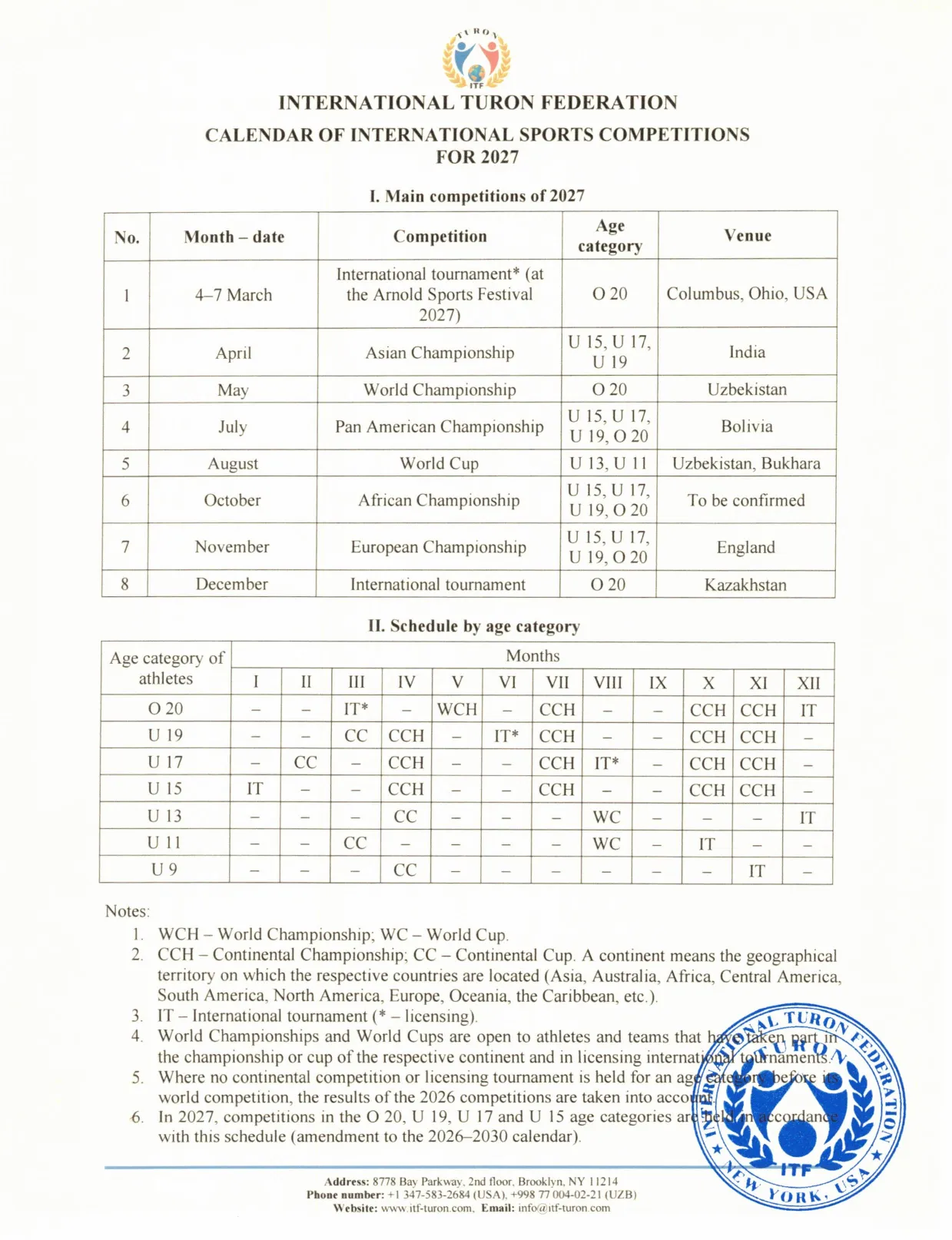
Eight main competitions on four continents — from the Arnold Sports Festival in Columbus in March to an international tournament in Kazakhstan in December.

Turon joins the Arnold Sports Festival for the first time

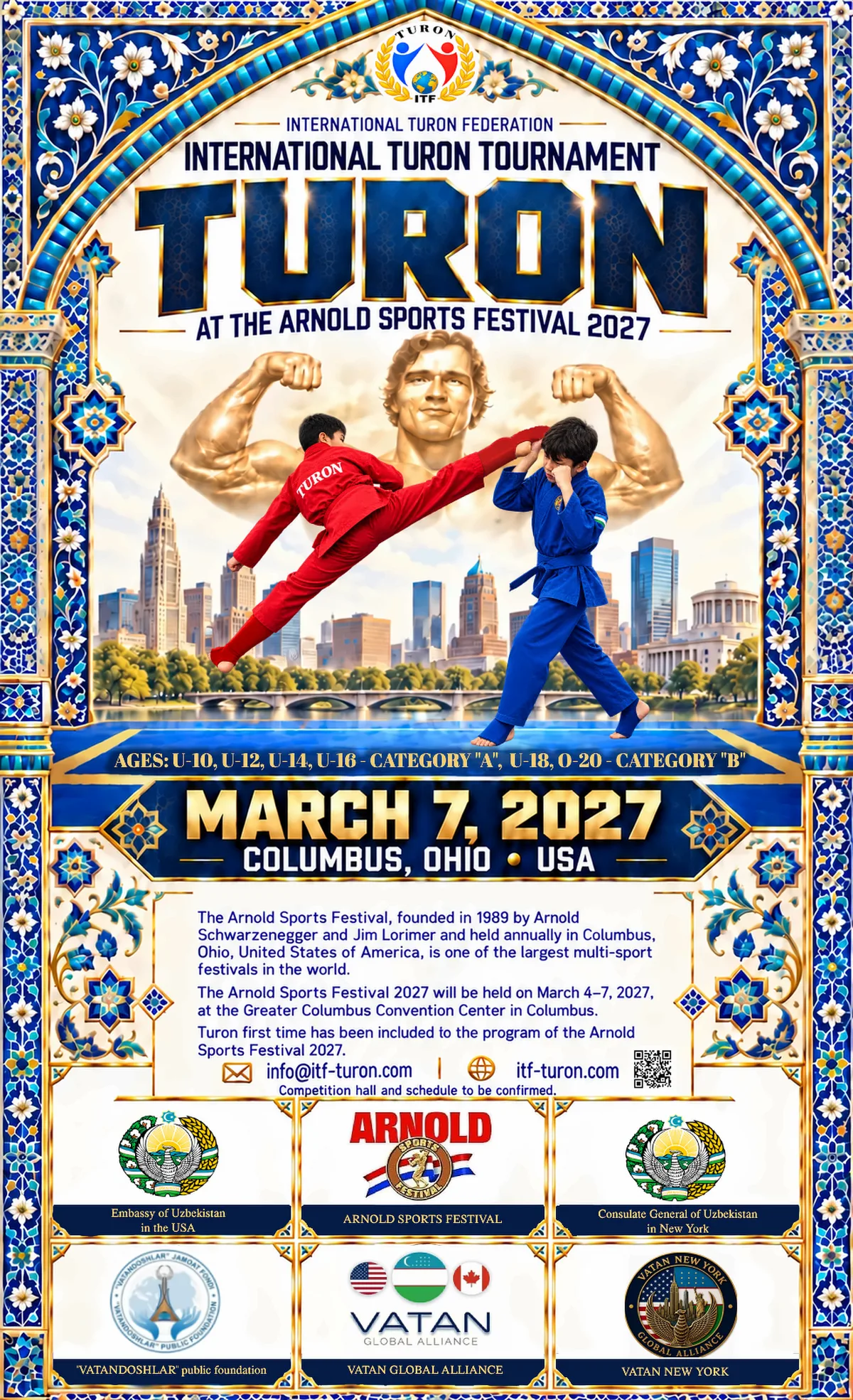
The International Turon Tournament will be held on 7 March 2027 in Columbus, Ohio, as part of one of the largest multi-sport festivals in the world.

From Uzbekistan to the Americas: building the Pan-American future of Turon

Turon’s Uzbek heritage is reaching athletes, coaches and organizations across Venezuela and the Americas. The goal now is a lasting Pan-American pathway.

Turon joins the ranks of the Bolivian Army

The Bolivian Turon Federation has signed a cooperation agreement with the country’s Army. Service members have begun Turon training at the Army Martial Arts School.

ITA free webinar on sports supplements

28 September, 17:00. Recommended for all coaches, referees and athletes on the instruction of the ITF President.

ITF and Alfraganus University sign memorandum in New York

The agreement opens a bachelor’s degree programme in Turon from the 2027/2028 academic year, establishing the academic foundation for training coaches and referees.

Bolivian federation signs agreement with El Alto Public University

The Bolivian Turon Federation has signed an institutional cooperation agreement with the Universidad Pública de El Alto. The aim is to develop Turon as a self-defence discipline within the university's physical education and sport programme. The document was signed by federation president César Castro Claure.

Membership network reaches 16 national federations

The federations of Bolivia, Indonesia, India, Uruguay and Peru have completed registration. Turon is now represented on four continents.

U-19 official protocols published

Four signed protocols covering free exercise and single combat, boys and girls, have been entered into the federation register.

Turon World Cup 2026 concludes in Tashkent

Held at the JAR Sports Complex from 1 to 5 June, the competition crowned medallists across the U-15, U-17, U-19 and senior categories.

Ministry order confirms 541 athletes

The entry list for the World Cup was formalised by order of the Ministry of Preschool and School Education.

National squad for 2026 announced

250 athletes across senior, junior, cadet and youth categories were named to the 2026 squad.

Competitions

Official calendar 2026–2030

Each age category has its own competition year: licensing tournaments, the continental cup and championship, and then the World Cup or the World Championship.

  1. 1
    Licensing tournamentStage 01
  2. 2
    Continental cup or championshipStage 02
  3. 3
    World Cup or World ChampionshipStage 03

03 · Equipment

Turon competition dress — blue and red

Equipment rules →

The official competition dress of Turon consists of four garments: the headscarf, the yahtak (upper garment), the wide trousers and the belt. On the mat the opponents take the blue and the red corner. Drag the model to turn it; use the buttons below to put each garment on or take it off.

Drag to rotate

The model is built from the equipment requirements in the Turon rules. Individual strikes and throwing techniques will be added to this section in 3D.

04 · In numbers

Turon today

1991Modern rules codified
by Bahodir Saidov
1992Added to Uzbekistan's
official sport list
1 526Athletes on register
U-15 / U-17 / U-19
250National squad
for 2026
16National member
federations
4Continents
represented

05 · History

Timeline of development

History of Turon
011991

Bahodir Saidov formulates the modern competition rules of Turon.

021992

Turon is included in the official list of sports of Uzbekistan.

031993

The Tashkent City Committee for Physical Culture and Sport registers Turon as an independent sport for the first time.

041994

The first official championship and tournament are held in Tashkent.

051995

Turon receives the status of a National Sport of Uzbekistan; the 1st official Championship of Uzbekistan is held; Andrey Smirnov becomes the first Turon athlete at the World Martial Arts Championship in Moscow.

061996

First sections open in Tajikistan, Turkmenistan, Kazakhstan and Russia; the 1st International Tournament is held in Tashkent; Turon appears at the UNESCO World Festival of National Sports and Folk Games in Bangkok.

071997

The competition rules are revised and recognised for the first time as official international rules.

081998

Turon is included in the programme of the 1st Youth Games of Uzbekistan.

092003

Turon enters the physical education textbook for general schools; the Charter of the Turon Federation of Uzbekistan is registered with the Ministry of Justice.

102004

The Turon Federation of Uzbekistan becomes a collective member of the National Olympic Committee; the Asian Turon Federation is founded; Turon enters the National Encyclopedia of Uzbekistan.

112005

The number of athletes in Uzbekistan passes 10,000.

122006

The President of Uzbekistan meets young Turon athletes and praises their performance.

132007

The 1st official Asian Championship is held in Nukus with teams from six countries; Turon athletes appear in the Uzbekfilm feature film «Bayvatcha».

142009

The European Academy of Turon is founded in Germany. On 5 December in Samarkand, representatives of seven countries hold the 1st Congress and establish the International Turon Federation; Bahodir Saidov is elected its first President.

152025

The International Turon Federation is founded at a conference in Tashkent and registered in New York on 15 July.

162026

The International Turon Federation, headquartered in New York, unites 16 national federations on four continents.

Roll of honour

U-19 champions of the World Cup 2026

Champions in every weight category, in both the free exercise and the single combat programme.

06 · The Federation

Governance and structure

Board and advisers →Charter →

The International Turon Federation is recognised under the laws of the United States as a non-profit international non-governmental organisation with corporate status. It holds exclusive authority for the coordination and development of all forms of amateur and professional Turon worldwide, and for staging all international Turon events.

Leadership

Farrukh NiyazimbetovPresidentUSA
Azizbek KholmuminovSecretary GeneralUSA
Jamshid KarimovExecutive DirectorUZB
Dilshod UsmonovChair, Technical CommissionUZB
Shokhrukh KhojimetovDirector of SportUZB
Samariddin KhikmatullayevHead of CommunicationUZB
Muhammaddamin UlmasovChief Specialist, Media DepartmentUZB
Abduaziz IsakulovHead of the International Legal Affairs DepartmentUSA

Vice Presidents

Ravshanbek AlmatovUSA
Dilmurod FozilovPresident, ASCTFUZB
Stephen SweetloveGBR
Ron HillUSA
Kadir Yusufog'luTUR
Sarvar RahmatovFinance and DevelopmentUZB
Sabrina BakhtiyorovaInternational RelationsUZB

Executive Committee

Robert ClarkChairUSA
Masa YoshizawaJPN
Enrique MatuteCAN
Patricio AvendanoCHI
Marco ContrerasMEX
Seven further membersFull list in the CharterITF

Advisers

Odil AbdurakhmanovAdviser to the PresidentUZB
Jamil SharapovAdviser to the PresidentUSA
Ravshan AkhmedjanovAdviser to the PresidentUZB
Akram SherdanaevAdviser to the PresidentUZB
Ravshan AkhmedjanovAdviser to the PresidentUZB
Bakhtiyor KhidoyatovAdviser to the PresidentUZB
All 5 advisers →

07 · Members

National federations

How to join →

Drag the globe · hover a country

UzbekistanCentral Asia
KazakhstanCentral Asia
EnglandEurope
United StatesNorth America
South KoreaEast Asia
JapanEast Asia
CanadaNorth America
TürkiyeEurope and Asia
MexicoNorth America
ChileSouth America
TajikistanCentral Asia
BoliviaSouth America
IndonesiaSoutheast Asia
IndiaSouth Asia
UruguaySouth America
PeruSouth America
ASCTFAsian Turon Association
Your country could be nextApply for membership
Full member — 16 national federations and one continental association

09 · Follow us

Latest from our official channels

@turon_itf →
Turon World Cup 2026 — U-19 champions decided. Tashkent, JAR Sports Complex.
Cooperation agreement signed with El Alto Public University. Bolivia.
National squad 2026 — 250 athletes named.

Membership

Register your national federation

Five steps, a checklist of the required documents and the downloadable application form.
Results

Roll of honour and competition protocols

Turon World Cup 2026 · U-19

Chief referee: A. Sherdanaev · Secretary: F. Tadjibayev · Tashkent, 1–5 June 2026

Membership

How to join the International Turon Federation

Register your national federation

Membership Regulations →

Membership is granted under the ITF Charter and the Membership Regulations. One national federation per country may hold full membership. An admitted federation is connected to the official competition calendar, the referee certification system and the international athlete register.

01Application The bilingual application form is completed and signed and stamped by the head of the applicant federation.
02Document review The Secretary General checks that the file is complete and returns it for completion if anything is missing.
03Executive decision The Executive Committee examines the application and decides on provisional membership.
04Ratification Full membership is ratified by vote at the next session of the General Assembly.
05Admission Once the membership fee is settled the federation receives its certificate and is entered on the members list.

Official forms

Download the ITF Membership Application Pack

The pack contains Forms 1–4 — the application, the composition of the leadership, the personal data form for each executive, and the declaration of acceptance of the ITF Charter and anti-doping rules. Forms are in English, Spanish and Russian.

Complete the forms, sign and stamp them, scan everything as PDF and send one e-mail with all attachments to the Secretary General: info@itf-turon.com

Required documents

  • Completed application form — signed and stamped
  • Statutes of the national federation
  • Certificate of state registration
  • List of the governing board — with roles and contacts
  • Evidence of national recognition of the sport
  • Federation emblem and flag — in vector format
  • Legal address and official contacts
  • Declaration accepting the ITF Charter and anti-doping rules

Categories of membership

Full memberOne national federation per country. Holds voting rights.A
Provisional memberFrom the Executive decision until ratification by the Assembly.B
Associate memberContinental associations and specialised bodies.C
Honorary memberIndividuals who have contributed to the development of Turon.D

Timing

Document reviewup to 30 days
Executive decisionnext session
Ratificationannual session

The procedure and timings follow the Membership Regulations (59 articles). The final wording is to be confirmed against the official document.

Online application

Apply online

Fill in the form and attach the signed application pack. The Secretariat confirms receipt and starts the document review.

01Federation
02Head of the federation
03Contact person, if different
04The federation today
05Documents and message

Programme 01

Free exercise

A competition in which one athlete or a group performs technical actions and techniques with different parts of the body or the whole body — standing, moving, shifting, and in unsupported positions.

Competition categories

Category AThe overall composition is free. Technical actions, positions, movements and the order of the component parts follow any sequence the athlete chooses.
Category BThe overall composition is performed compulsorily, according to a set programme.
Held betweenMen separately, women separately, and mixed — men and women together.
FormsIndividual and group.

Performing the composition

ApparatusMay be performed with or without special sports apparatus — the rope, the staff and the sword.
MusicMay be performed with or without rhythmic musical accompaniment.
TimeSenior and middle age groups — no more than two (2) minutes. Junior age group — up to one (1) minute.
Place and repetitionThe composition may begin and end at any part of the mat, and is performed once only.

Judging

ScaleTechnical actions and elements completed inside the working zone are judged on a ten-point scale.
CriteriaStability, complexity, speed, cleanliness, amplitude, variety of movement, rhythm and presentation.
Points recordedEvaluating points — shown by all judges. Penalty point — shown by the majority of judges, signalled with a yellow card.

Format and the winner

With eliminationAthletes who do not reach the qualifying score set by the judging panel are eliminated. That score may not be changed.
Without eliminationAll athletes perform once only; the maximum score is set by the judging panel.
WinnerThe winner is decided on the total sum of points. Mixing the two systems during a competition is prohibited.
Tie-breakBreaking special equipment decides. Hand or foot technique only, one attempt only; the athlete stops immediately after the action. Failing to break it means defeat.

Dress and age

DressUniform, socks, and sports shoes with a smooth sole of leather, rubber or other soft synthetic material. With a white uniform a red or blue headscarf is worn, with white socks and shoes.
Age groupsCategory A is open from ages 7–9 upwards; category B from ages 10–11 upwards.
ProhibitedVerbal speech and indecent behaviour; performing any technical action or element after the judges have ordered all action to stop.

Implements, judging and rank requirements →

Source: Turon competition rules (ITF). Full text in the Documents section.

Programme 02

Single combat

A bout in which two athletes face each other using the full technical and tactical arsenal: strikes delivered with different parts of the body, and techniques that change the opponent’s position or restrict their movement.

Technical arsenal

Zarba — strikesTypes and forms of strike delivered with different parts of the body.
Usul — techniquesThrows, knockdowns, catches, trips, painful and choking techniques, and any other technique aimed at changing the opponent’s position or restricting their actions.
Category APerforming any technical action while holding or embracing any part of the opponent’s uniform is prohibited.
Category BNo restriction is placed on performing any technical action or technique.

Structure of the bout

Two partsEvery bout consists of two parts: senior — five (5) minutes each, middle — three (3) minutes, junior — two (2) minutes.
Rest between partsOne (1) minute.
Extra timeThe bout is held once. If the result is level, one additional bout of one (1) minute decides the winner.
Rest before a boutSenior — at least ten (10) minutes, middle — at least twenty (20), junior — at least thirty (30). Athletes begin from the centre of the mat.
Mat size8×8 m for the junior group, 10×10 m for the middle group and 12×12 m for the senior group.

Scoring

Open judgingEach technique performed is worth one point, whatever its type or form. Only the score shown by the referee is recorded.
Penalty pointEach penalty point removes two (2) score points. When a penalty point is given, the opponent receives no score points.
Referee interventionIf the referee intervenes while a technique is being performed, that technique is not scored.
Painful techniqueRecorded when held for no more than four to five (4–5) seconds; any cry or movement from the athlete held counts as submission.
Count of eightIf an athlete is stunned, the referee counts. If the athlete cannot show readiness to continue after the count of eight, the opponent is declared the winner.

Deciding the winner

InjuryAn athlete is declared the loser if they injure the opponent through a breach of the rules, or if they are themselves injured by permitted actions or accidental contact. If both are injured by mutual action, the score recorded before the injury decides.
Tie-breakThe evaluation post decides. Foot techniques only, one (1) minute maximum, from a single firm point of support — jumping or turning is not allowed. The athlete loses if they perform fewer actions or knock the post over.
DressAdmitted only in red or blue uniform, with helmet, gloves and boots.
Age groupsCategory A is open from ages 10–11 upwards; category B from ages 12–13 upwards. Men and women do not compete against each other.

Prohibited actions

Head contact in category AAny contact strike to the opponent’s head: with the head or the hand in any position; with the foot when the opponent is half-seated, seated or lying, markedly bent over, supporting themselves on their hands, or when the athlete is in a low stance.
OtherActions that damage the spine; any action outside the working area of the mat; any action after the referee has ordered all action to stop; verbal speech and indecent behaviour.

Source: Turon competition rules (ITF). Full text in the Documents section.

Programme 03

All-round

In all-round competition the athlete performs in both programmes — single combat and free exercise. The absolute championship is an independent competition programme in which age categories are taken into account but weight categories are not.

What the programme consists of

Both programmesThe athlete competes in single combat and in free exercise. The rules of each programme apply in full; the special conditions for all-round competition approved by the ITF form an integral part of the rules.
Weight categoriesIn the absolute championship weight categories are not taken into account. Athletes may also be entered in absolute weight-category competitions where required.
Age categoriesAge categories are taken into account and are determined by year of birth. An athlete one year younger may be admitted in the prescribed manner; entering an older athlete is prohibited.

Requirements for the athlete

Two sets of dressSingle combat requires a red or blue uniform with helmet, gloves and boots. Free exercise requires the uniform with socks and smooth-soled sports shoes. The athlete must be prepared for both.
Appearances per daySenior and middle groups — no more than three (3) appearances in one competition day; junior group — no more than two (2).
AdmissionThe athlete must pass the mandate commission, compete strictly in their own age category, and appear only in the type and category for which they are registered, with the drawn number on the back of the uniform.

How the result is formed

Free exercise partJudged on the ten-point scale for stability, complexity, speed, cleanliness, amplitude, variety, rhythm and presentation. The result is the total sum of points.
Single combat partEach technique performed is worth one point; each penalty point removes two. Bouts run in two parts with an extra minute if the result is level.
Bonus pointA bonus of +1 point is given for winning an additional appearance, for winning at the evaluation post, and for winning the breaking of special equipment.
Minimum entryCompetitions are held in a weight category if at least four (4) athletes take part. Amateur competitions are open to all age groups; professional status competitions are held only among senior groups II and III.

Terminology

Official terms onlyDuring competition in both programmes, judges, delegates, athletes, coaches and other specialists are prohibited from using any term that does not correspond to, or that replaces, the official terminology set out in the rules.
SanctionsDisrespectful or careless treatment of the terminology may bring sanctions on the person and on the team or delegation concerned.

Source: Turon competition rules (ITF). Full text in the Documents section.

The sport of Turon

The history of Turon: from ancient roots to the world stage

How the martial heritage of the peoples of historical Uzbekistan became a modern international sport — its origins, its development and what it has achieved.

Ancient roots

Uzbekistan’s history is rich in martial traditions. Manuscripts describing a highly developed culture of physical training are part of the nation’s historical heritage.

ArchaeologyExcavations in the Khorezm, Bukhara, Samarkand, Kashkadarya, Andijan, Fergana and Tashkent regions uncovered fragments of frescoes showing people in combat poses.
The Great Silk RoadManuscripts of different eras record performances by fighters at festivals and the high esteem in which those who guarded caravans on the Silk Road were held. Their courage, nobility and honesty became legendary — as the historians Abu Bakr Narshakhi and Ali Yazdi attest.
Great thinkersKaffol ash-Shashi, al-Tirmidhi, al-Khwarizmi, Imam al-Bukhari, Ibn Sina, al-Biruni and Alisher Navoi left valuable information on the importance of physical culture and on the skill of the fighters of their time.

Meaning of the name

A peopleIn some sources “Turon” names a tribe or people of antiquity (Manuchehr Damghani, 10th–11th c.; Khaqani Shirvani, 12th c.).
A landIn others it is the territory of an ancient state (Ibn Khordadbeh, 9th c.; Muhammad ibn Yusuf al-Khwarizmi, 9th–10th c.; al-Tabari).
A qualityIn the ancient languages of the region — Arabic, Persian, Turkic and Sanskrit — the root “Tur, Tura” meant skilful, strong, fearless (the Avesta and other sources). That is why the modern sport was named Turon: its athletes need agility, strength and firm moral qualities.

Birth of the modern sport

FounderThe foundation of modern Turon was laid by the international-class master of sport Bahodir Saidov, who studied historical records of the types, forms and styles of ancient Uzbek martial arts and created a complete new set of documents defining its sporting direction.
Pioneer athletesDmitry Zhuravlev, Abylkasym Kenzhebaev, Chary Mergenov, Timur Fattakhov, Jamoliddin Dadakuziev, Erkin Akramov, Artur Rabinovich, Igor Ovchinnikov, Dmitry Nogai, Avaz Khusnutdinov, Andrey Savkin, Sergey Vertkov, Walter Jager, Andrey Smirnov, Evgeniya Kruglova and many others opened the road for the young sport.
Regional pioneersThe first promoters across Uzbekistan’s regions included Murat Sarsenbaev (Karakalpakstan), Bakhtiyor Khidoyatov and Akrom Sherdanaev (Tashkent region), Gulchekhra Abdurasulova (Fergana), Dilmurot Fazylov (Bukhara), Semyon Pak (Jizzakh), Aziz Bobomuradov (Samarkand) and Kudrat Jumaniyazov (Khorezm).

Timeline of development

1991Bahodir Saidov formulates the modern competition rules of Turon.
1992Turon is included in the official list of sports of Uzbekistan.
1993The Tashkent City Committee for Physical Culture and Sport registers Turon as an independent sport for the first time.
1994The first official championship and tournament are held in Tashkent.
1995Turon receives the status of a National Sport of Uzbekistan; the 1st official Championship of Uzbekistan is held; Andrey Smirnov becomes the first Turon athlete at the World Martial Arts Championship in Moscow.
1996First sections open in Tajikistan, Turkmenistan, Kazakhstan and Russia; the 1st International Tournament is held in Tashkent; Turon appears at the UNESCO World Festival of National Sports and Folk Games in Bangkok.
1997The competition rules are revised and recognised for the first time as official international rules.
1998Turon is included in the programme of the 1st Youth Games of Uzbekistan.
2003Turon enters the physical education textbook for general schools; the Charter of the Turon Federation of Uzbekistan is registered with the Ministry of Justice.
2004The Turon Federation of Uzbekistan becomes a collective member of the National Olympic Committee; the Asian Turon Federation is founded; Turon enters the National Encyclopedia of Uzbekistan.
2005The number of athletes in Uzbekistan passes 10,000.
2006The President of Uzbekistan meets young Turon athletes and praises their performance.
2007The 1st official Asian Championship is held in Nukus with teams from six countries; Turon athletes appear in the Uzbekfilm feature film «Bayvatcha».
2009The European Academy of Turon is founded in Germany. On 5 December in Samarkand, representatives of seven countries hold the 1st Congress and establish the International Turon Federation; Bahodir Saidov is elected its first President.
2010The Charter of the International Turon Federation is state-registered (No. 715).

The first champions

1996 · InternationalFirst international tournament in Tashkent: Abylkasym Kenzhebaev (60 kg, Kazakhstan), Chary Mergenov (65 kg, Turkmenistan), Timur Fattakhov (70 kg, Uzbekistan), Artur Rabinovich (75 kg, Uzbekistan), Dmitry Zhuravlev (80 kg, Russia).
1996 · Master of sportAndrey Smirnov (Tashkent) receives the first title of Master of Sport of Uzbekistan in Turon.
1998 · RefereeJamoliddin Dadakuziev (Tashkent) becomes the first referee of the Republican category.
2007 · AsiaThe first Asian champions are crowned in Nukus, in senior and youth categories for men and women.

Turon today

The FederationThe International Turon Federation is a non-profit international organisation under the laws of the United States, headquartered in Brooklyn, New York.
MembershipThe membership network has reached 16 national federations, and Turon is now represented on four continents.
World Cup 2026The Turon World Cup was held in Tashkent on 1–5 June 2026 at the JAR Sports Complex, across the U-15, U-17, U-19 and senior categories and both programmes of the sport.
PartnershipsMemoranda signed in New York with the International Kurash Association and with Alfraganus University, which opens a bachelor’s programme in Turon from the 2027/2028 academic year; the Bolivian federation has an agreement with the Public University of El Alto.

Source: official historical chronicle of the International Turon Federation.

Media

Turon in the media: a database of publications

Where and when Turon and the International Turon Federation have been written about — with the source, the date and a direct link to each publication.

International press

Publications outside Uzbekistan and reports by state news agencies in foreign languages.

12.08.2026UZA — O‘zbekiston Milliy axborot agentligiEN

Promotion of Kurash and Turon martial arts discussed in the United States ↗

On the memorandum between the ITF and the International Kurash Association, and the plan for a first joint event in Manhattan.

08.2026The Bukharian Times (Nyu-York)EN

Turon and Kurash Take On NYC — Together ↗

A detailed report on the signing at the ITF headquarters, with the composition of both delegations.

08.02.2026Dunyo IAEN

International Turon Federation Enters a New Stage of Development ↗

On the federation’s growth, the work in Bolivia and the establishment of the British Turon Association.

05.05.2026Dunyo IARU

Американским сенаторам представлен узбекский вид единоборства турон

Turon presented to United States senators. Listed in the agency’s sport section — the direct link is being confirmed.

13.11.2025Dunyo IAEN

Young compatriot presents the book “New Uzbekistan” to his peers in New York ↗

A mention of the ITF: the speaker is the son of the federation’s President.

National press

09.2026Yuz.uzRU

К 35-летию независимости Узбекистана «Турон» объединил 35 государств мира ↗

An interview with the ITF President on the geography of the sport and its role as a sporting ambassador of Uzbekistan.

12.06.2025UZA — O‘zbekiston Milliy axborot agentligiRU

Состоялась учредительная конференция Международной федерации единоборства Турон ↗

The founding conference: the decision to place the headquarters in New York and the election of the President.

Official portals and reference works

—gov.uz — O‘zbekiston hukumat portaliRU

Национальные виды спорта ↗

The government portal’s description of Turon among the national sports of Uzbekistan.

—usport.uz / ZiyonetUZ

Turon yakka kurashi — milliy sport turi ↗

A reference entry: history, rules, the two programmes and the national federation’s details.

—itf-turon.comEN

History of the Turon — official federation website ↗

The official account of the origin of the sport and the meaning of its name.

Academic and teaching sources

2012Ziyonet elektron kutubxonasiUZ

Turon (o‘quv qo‘llanma) — B. Saidov ↗

The founder’s own manual: the history of the sport, terminology and a chronology of its development.

2021Jizzax davlat pedagogika universitetiUZ

Turon — B. Saidov (PDF) ↗

The same manual published on a university site as teaching material.

2023Interpretation and Researches (ilmiy jurnal)UZ

Turon yakka kurashi mashg‘ulotlarida texnik va taktik tayyorgarlik bosqichlari ↗

An academic article on the methodology of technical and tactical preparation.

This archive is maintained by the Secretariat and is updated as new material appears. If you know of a publication that is missing, write to info@itf-turon.com.

Referee registry

Verify a card →

Official register of referees licensed by the International Turon Federation.

The QR code on every ITF referee card opens the card's record. Search by surname, given name or serial number.

    Referee categories and certification

    Officiating regulations →
    «A» — InternationalLicence issued by the ITF. Valid for 5 years.Register →
    «B» — ContinentalTraining through a continental Confederation; licence issued by the ITF. Valid for 4 years.Register →
    «C» — NationalTraining through a national Federation; licence issued by the ITF. Valid for 3 years.Register →
    «D» — RegionalTraining through a national Federation; licence issued by the ITF. Valid for 2 years.Register →

    Chair of the Referee Board — Dilshod Usmonov. Certifications and category awards are published in this section.

    Documents

    Charter, regulations and official forms

    Competitions

    The official calendar and the competition system

    1. 2027-12International Tournament · KZ
    2. 2027-11European Championship · England
    3. 2027-10African Championship
    4. 2027-08World Cup · Bukhara
    5. 2027-07Pan American Championship · BO
    6. 2027-05World Championship · UZ
    7. 2027-04Asian Championship · IN
    8. 2027-03-04 – 2027-03-07International Tournament · Arnold Sports Festival 2027 · Columbus, Ohio
    9. 2026-06-01 – 2026-06-05Turon World Cup 2026 · JAR Sports Complex, Tashkent
    10. 2022Asian Cup · Bukhara

    Each age category has its own competition year. The season starts with licensing tournaments, moves through the continental cup and championship, and finishes at the World Cup or the World Championship. To reach a world event an athlete must first have competed at continental level and in a licensing tournament.

    1Licensing tournament2Continental cup or championship3World Cup or World Championship

    Governance

    Leadership, board and advisers

    ← Board and advisers

    Leadership

    Farrukh Niyazimbetov

    President

    Country
    United States
    Body
    Leadership

    Biography

    Founder and President of the International Turon Federation. The founding conference in Tashkent in 2025 unanimously approved him as President and tasked him with registering the federation in New York, building its membership and staging the first Turon World Cup. The federation was registered in New York on 15 July 2025, and the 2026 World Cup was held in Tashkent.

    A detailed biography will be published soon.

    ← Board and advisers

    Leadership

    Azizbek Kholmuminov

    Secretary General

    Country
    United States
    Body
    Leadership

    Biography

    Secretary General of the International Turon Federation. Master of Sport of International Class in Turon, winner of the Turon World Cup, Asian champion and five-time champion of Uzbekistan, with many achievements in other sports as well.

    ← Board and advisers

    Leadership

    Jamshid Karimov

    Executive Director

    Country
    Uzbekistan
    Body
    Leadership

    Biography

    Acting Chairman of the Turon Yakkakurash Federation of Uzbekistan, Master of Sport and highest-category coach. Reviewer of the ITF Regulation on international sport titles and ranks.

    A detailed biography will be published soon.

    ← Board and advisers

    Leadership

    Dilshod Usmonov

    Chair, Technical Commission

    Country
    Uzbekistan
    Body
    Leadership

    Biography

    A detailed biography will be published soon.

    ← Board and advisers

    Leadership

    Shokhrukh Khojimetov

    Director of Sport

    Country
    Uzbekistan
    Body
    Leadership

    Biography

    A detailed biography will be published soon.

    ← Board and advisers

    Leadership

    Samariddin Khikmatullayev

    Head of Communication

    Country
    Uzbekistan
    Body
    Leadership

    Biography

    A detailed biography will be published soon.

    ← Board and advisers

    Leadership

    Muhammaddamin Ulmasov

    Chief Specialist, Media Department

    Country
    Uzbekistan
    Body
    Leadership

    Biography

    Chief Specialist of the Media Department of the International Turon Federation. Born in 2001 in Tashkent.

    Master of Sport of Uzbekistan in Turon Yakkakurash, highest-category coach and international-category referee.

    Since September 2022 he has studied at the Faculty of Physical Culture of Tashkent State Pedagogical University named after Nizami.

    ← Board and advisers

    Leadership

    Abduaziz Isakulov

    Head of the International Legal Affairs Department

    Country
    United States
    Body
    Leadership

    Biography

    Head of the International Legal Affairs Department of the International Turon Federation.

    A detailed biography will be published soon.

    ← Board and advisers

    Vice Presidents

    Ravshanbek Almatov

    Country
    United States
    Body
    Vice Presidents

    Biography

    A detailed biography will be published soon.

    ← Board and advisers

    Vice Presidents

    Dilmurod Fozilov

    President, ASCTF

    Country
    Uzbekistan
    Body
    Vice Presidents

    Biography

    A detailed biography will be published soon.

    ← Board and advisers

    Vice Presidents

    Stephen Sweetlove

    Country
    United Kingdom
    Body
    Vice Presidents

    Biography

    A detailed biography will be published soon.

    ← Board and advisers

    Vice Presidents

    Ron Hill

    Country
    United States
    Body
    Vice Presidents

    Biography

    A detailed biography will be published soon.

    ← Board and advisers

    Vice Presidents

    Kadir Yusufog'lu

    Country
    Türkiye
    Body
    Vice Presidents

    Biography

    A detailed biography will be published soon.

    ← Board and advisers

    Vice Presidents

    Sarvar Rahmatov

    Finance and Development

    Country
    Uzbekistan
    Body
    Vice Presidents

    Biography

    A detailed biography will be published soon.

    ← Board and advisers

    Vice Presidents

    Sabrina Bakhtiyorova

    International Relations

    Country
    Uzbekistan
    Body
    Vice Presidents

    Biography

    A detailed biography will be published soon.

    ← Board and advisers

    Executive Committee

    Robert Clark

    Chair

    Country
    United States
    Body
    Executive Committee

    Biography

    Reviewer of the ITF Regulation on international sport titles and ranks.

    A detailed biography will be published soon.

    ← Board and advisers

    Executive Committee

    Masa Yoshizawa

    Country
    Japan
    Body
    Executive Committee

    Biography

    A detailed biography will be published soon.

    ← Board and advisers

    Executive Committee

    Enrique Matute

    Country
    Canada
    Body
    Executive Committee

    Biography

    A detailed biography will be published soon.

    ← Board and advisers

    Executive Committee

    Patricio Avendano

    Country
    Chile
    Body
    Executive Committee

    Biography

    A detailed biography will be published soon.

    ← Board and advisers

    Executive Committee

    Marco Contreras

    Country
    Mexico
    Body
    Executive Committee

    Biography

    A detailed biography will be published soon.

    ← Board and advisers

    Advisers

    Odil Abdurakhmanov

    Adviser to the President

    Country
    Uzbekistan
    Body
    Advisers

    Biography

    Odil Qalandarovich Abdurakhmanov was born on 6 February 1978. He holds bachelor’s and master’s degrees from Tashkent State University of Economics and a Doctor of Economics degree.

    In July 2018 he became First Deputy Minister of Higher and Secondary Specialised Education, and in 2019 Deputy Adviser to the President on science, education, health and sport. From June 2020 he was Rector of Tashkent State Transport University. In 2022–2023 he served as Adviser to the President on youth policy, science, education, health, culture and sport, and in 2023 he became Head of the Department of Social Development of the Administration of the President of the Republic of Uzbekistan.

    He is the Representative of the President of the Republic of Uzbekistan for Sport and the President of the Bodybuilding and Fitness Federation of Uzbekistan. In the International Turon Federation he serves as Adviser to the President.

    ← Board and advisers

    Advisers

    Jamil Sharapov

    Adviser to the President

    Country
    United States
    Body
    Advisers

    Biography

    Consul General of the Republic of Uzbekistan in New York. Before this appointment he held various positions at the Ministry of Foreign Affairs of Uzbekistan and at the Institute for Strategic and Interregional Studies under the President of the Republic of Uzbekistan.

    A detailed biography will be published soon.

    ← Board and advisers

    Advisers

    Akram Sherdanaev

    Adviser to the President

    Country
    Uzbekistan
    Body
    Advisers

    Biography

    A devoted servant of Turon, Akram Sherdanaev has put many years of selfless work into the development of the sport and is held in high regard across the Turon community.

    Master of Sport and Master of Sport of International Class in Turon. Co-author, with Bahodir Saidov and colleagues, of the Turon curriculum for youth sports schools, schools of the Olympic reserve and schools of higher sporting excellence (2002).

    ← Board and advisers

    Advisers

    Ravshan Akhmedjanov

    Adviser to the President

    Country
    Uzbekistan
    Body
    Advisers

    Biography

    Born in 1964 in Tashkent. He graduated from the State Institute of Physical Culture and Sport in Tashkent (1986–1991).

    His coaching career was built in sambo. He led Uzbekistan's national team as head coach (1999–2013) and headed the national association as its President (2013–2019). At continental level he was Vice-President of the Asian federation (2005–2013) and Technical Director of the Asian union (2013–2019). Since 2013 he has coached the national team at the Republican School of Higher Sports Mastery in Combat Sports in Tashkent.

    Honoured Coach of the Republic of Uzbekistan, Master of Sport of the USSR, international-category referee and highest-category coach; holder of the “Excellent Worker of Physical Culture and Sport” badge. He was named Uzbekistan’s best coach of the year in 2001 and 2003.

    He has trained about 25 Masters of Sport of Uzbekistan, 10 Masters of Sport of International Class and more than 50 Candidates for Master of Sport, including champions and medallists of national, continental and world championships.

    ← Board and advisers

    Advisers

    Bakhtiyor Khidoyatov

    Adviser to the President

    Country
    Uzbekistan
    Body
    Advisers

    Biography

    Master of Sport of Uzbekistan of International Class in Turon Yakkakurash. Author of the ITF Regulation on international sport titles and ranks.

    A detailed biography will be published soon.

    ITF Regulation

    Sport titles and ranks

    The Regulation on awarding international sport titles and ranks to Turon athletes: three titles, seven ranks, the belts and badges that mark them, and what an athlete has to show to earn each one.

    Reviewers

    N.Sh. BobomuradovReviewer · Professor, PhD, Department of Adaptive Physical Education and Para-sport, Uzbekistan State University of Physical Education and Sport
    F. NiyazimbetovReviewer · President of the International Turon Federation
    Robert ClarkReviewer · Board member for work with members, International Turon Federation
    J. KarimovReviewer · Acting Chairman of the Turon Yakkakurash Federation of Uzbekistan, Master of Sport, highest-category coach

    01 · Three titles, seven ranks

    Three titles, seven ranks

    Titles and ranks are shown by the belt: black with white stripes for the titles, a coloured belt with one stripe for each rank. At the end of every belt the word TURON is embroidered in gold.

    TitleHonoured Master
    Black belt, three white stripes · gold badge

    World Championship and Absolute World Championship

    TitleInternational Master
    Black belt, two white stripes · silver badge

    World and Asian championships

    TitleMaster
    Black belt, one white stripe · red-gold badge

    World, Asian, international and national competitions

    RankI rank
    Red belt, black stripe

    International tournaments; regional and national competitions

    RankII rank
    Blue belt, black stripe

    Regional and national competitions

    RankIII rank
    Green belt, black stripe

    Regional and national competitions

    RankIV rank
    White belt, black stripe

    District and city competitions

    RankV rank
    White belt, red stripe

    District and city competitions

    RankVI rank
    White belt, blue stripe

    Club competitions

    RankVII rank
    White belt, green stripe

    Club competitions

    Title badges are round, 25 mm across, with the federation emblem: the globe framed by laurel branches joined by a black belt with one, two or three white stripes. Rank badges measure 2.3 × 2.5 cm and are made of yellow metal.

    02 · How a title is earned

    How a title is earned

    1. Titles and ranks are earned at official competitions in free exercise, single combat and the all-round programme — by taking a set place, winning, or scoring a set number of points.
    2. Honoured Master and International Master need athletes from at least 6 countries at the event, Master at least 4. At national competitions a weight category needs at least 10 athletes.
    3. Titles are awarded only by the International Turon Federation; ranks are awarded by national federations with its consent.
    4. Men and women are awarded in the same way, by age and weight category, and each title or rank only once — whether the athlete is an amateur, a professional or a veteran.
    5. Every title or rank is entered in the athlete's sport passport. Certificates, badges and belts are issued in the federation's official languages through the national federation, after the fee is paid.
    Free exercise · seniors (20+): place and points needed
    CompetitionHonoured MasterInternational MasterMaster
    World Championship1–3 · 854–5 · 805–6 · 78
    Absolute World Championship1–3 · 854–5 · 805–6 · 78
    World Cup——1–6 · 78.4
    Asian Championship—1 · 902–8 · 80
    Absolute Asian Championship—1 · 902–8 · 80
    Asian Cup——1–6 · 85
    International tournaments——1–4 · 83.5
    National championship——1–3 · 85
    National absolute championship——1–4 · 80
    National cup——1–3 · 85

    Place · points. Juniors aged 16–19 can earn the Master title at the same events; the Regulation sets their places and points, and those for every rank and age group.

    03 · Age groups and programmes

    Age groups and programmes

    7–9ChildrenU7–U9
    10–11Younger juniorsU10–U11
    12–13JuniorsU12–U13
    14–17YouthU14–U17
    18+AdultsU18–U19 · O20
    Free exercise · category ATitles and ranks fromU7
    Single combat · category ATitles and ranks fromU10
    Single combat · category BTitles and ranks fromU14
    All-round · category ATitles and ranks fromU16
    All-round · category BTitles and ranks fromU18

    04 · Yaxtak — the Turon uniform

    Yaxtak — the Turon uniform

    Peshonabog' — headband

    A square of soft red or blue cloth, folded diagonally and tied from the forehead to the back of the head; the ends hang 5–8 cm.

    Ko'ylak — jacket

    Loose, of durable fabric, with no cords or coloured stripes; white, red or blue. Pulled on over the head, it covers the hips and has two slits on each side for the belt.

    Ishton — trousers

    Loose, of durable fabric, white, red or blue, covering the ankles; a three-row waistband with elastic in the outer rows and a cloth cord in the middle.

    Belbog' — belt

    No wider than 5 cm, passed through the jacket's slits, wrapped twice round the waist and tied with a double knot in front; the ends are no longer than 20 cm.

    05 · Five implements of free exercise

    Five implements of free exercise

    The demonstration with traditional tools follows a fixed order — rope, stick, sword, sickle, ketmon — and ends in a final position. Judges look at technique, accuracy, coordination, balance and control of the implement, not at the force of a blow.

    01Arqon — ropeRhythm, agility and coordination
    02Tayoq — stickAccuracy, balance and control
    03Qilich — swordBalance and a sense of distance
    04O'roq — sickleAgility and balance
    05Ketmon — hoeCoordination of body and step

    Safety

    • Only blunt, safe sport replicas are used — never real tools; the rope is soft.
    • No swinging, throwing or striking towards another person; athletes keep a safe distance.
    • A judge or official checks every replica before training and competition; breaking a safety rule stops the exercise.

    06 · How free exercise is judged

    How free exercise is judged

    1. 01Accuracy of technique
    2. 02Difficulty of the movements
    3. 03Speed
    4. 04Precision and amplitude
    5. 05Variety
    6. 06Sequence
    7. 07Balance
    8. 08Rhythm
    9. 09Performance and aesthetics
    10. −minus penalty points
    Scored separatelywithout an implement, and with rope, stick, sword, sickle and ketmon
    Individual and teamteams of five perform the compulsory elements together, in unison
    One roundup to 1 minute for children, up to 1.5 minutes from 16
    Musicchosen by the coach; without music 5 points are deducted
    Area12 × 12 m for a rope routine, 24 × 24 m for a team

    08 · Literature on Turon

    Literature on Turon

    1. Bahodir SaidovТурон. Подготовка спортсменов высокого классаTashkent, 1999
    2. Bahodir SaidovКонцепция развития единоборства ТуронTashkent, 2004
    3. Bahodir SaidovMusobaqalarni o'tkazish qoidalariTashkent, 2005
    4. Bahodir SaidovЕдиноборство Турон в системе физического воспитанияTashkent, 2008
    5. Bahodir SaidovОбучение единоборству ТуронTashkent, 2008
    6. Bahodir SaidovТренировка в единоборстве ТуронTashkent, 2008
    7. Bahodir SaidovУчебная программа по единоборству ТуронTashkent, 2008
    8. Bahodir SaidovМесто проведения занятий, инвентарь, спортивная форма и средства защиты в единоборстве ТуронTashkent, 2009
    9. Bahodir Saidov et al.Учебная программа для ДЮСШ, СДЮШОР и школ высшего спортивного мастерства2002
    10. S. Sodiqov et al.Turon yakkakurashini 1–4-sinf jismoniy tarbiya darslarida qo'llash2010

    Newsroom

    News and announcements from the International Turon Federation

    Calendar · 2027

    ITF approves the 2027 competition calendar

    Eight main competitions on four continents — from the Arnold Sports Festival in Columbus in March to an international tournament in Kazakhstan in December.

    Competition · USA

    Turon joins the Arnold Sports Festival for the first time

    The International Turon Tournament will be held on 7 March 2027 in Columbus, Ohio, as part of one of the largest multi-sport festivals in the world.

    Opinion · The Americas

    From Uzbekistan to the Americas: building the Pan-American future of Turon

    Turon’s Uzbek heritage is reaching athletes, coaches and organizations across Venezuela and the Americas. The goal now is a lasting Pan-American pathway.

    South America

    Turon joins the ranks of the Bolivian Army

    The Bolivian Turon Federation has signed a cooperation agreement with the country’s Army. Service members have begun Turon training at the Army Martial Arts School.

    Announcement

    ITA free webinar: “Ask the Expert: Supplements — Part II”

    The International Testing Agency holds a free online webinar on sports supplements, their safety and compliance with anti-doping rules. On the instruction of the ITF President, all coaches, referees and athletes are recommended to take part.

    Education and science

    ITF and Alfraganus University sign memorandum in New York

    The agreement opens a bachelor’s degree programme in Turon from the 2027/2028 academic year, establishing the academic foundation for training coaches, referees and specialists in the sport.

    Development

    Turon takes root in Bolivia

    A year after the national federation was founded, children's groups are training weekly in El Alto and the sport has reached the city's public university.

    International cooperation

    Turon and Kurash sign Memorandum of Understanding in New York

    The International Turon Federation and the International Kurash Association have agreed a framework for long-term cooperation, and will stage their first joint event in Manhattan in October.

    Development

    Bolivian federation signs agreement with El Alto Public University

    Turon enters higher education in Latin America for the first time, as a self-defence discipline within the university's sport programme.

    Membership

    Membership network reaches 16 national federations

    The federations of Bolivia, Indonesia, India, Uruguay and Peru have completed registration. Turon is now represented on four continents.

    Results

    U-19 official protocols published

    Four signed protocols cover free exercise and single combat, for boys and for girls.

    Competition

    Turon World Cup 2026 concludes in Tashkent

    Five days at the JAR Sports Complex brought together the U-15, U-17, U-19 and senior categories across both programmes of the sport.

    Competition

    Ministry order confirms 541 athletes

    The entry list for the Turon World Cup 2026 was formalised by order of the Ministry of Preschool and School Education of the Republic of Uzbekistan. The annex to the order named 541 athletes; a further 68 were added through a supplementary registration list.

    Federation

    The International Turon Federation enters a new stage of development

    The federation is widening its international work and strengthening the place of Uzbekistan’s national martial art on the world stage, the Dunyo news agency reports.

    Uzbekistan

    National squad for 2026 announced

    250 athletes across the senior, junior, cadet and youth categories were named to the 2026 squad of Uzbekistan. The roster became the pool from which the team for the Turon World Cup 2026 was selected.

    Calendar

    ITF approves the international competition calendar to 2030

    The cycle sets a fixed rhythm for every age category, from licensing tournaments through continental events to the world stage.

    Federation

    The International Turon Federation is registered in New York

    The federation was officially registered by the Department of State of New York.

    Federation

    The International Turon Federation is founded in Tashkent

    A founding conference in Tashkent approved the charter, the emblem and the first President of the federation.

    ← All articlesCalendar · 2027

    ITF approves the 2027 competition calendar

    On 30 October 2026 the International Turon Federation sent national federations, associations and sports organisations its official calendar of international competitions for 2027 (letter No. A38-26, signed by ITF President Farrukh Niyazimbetov).

    The season opens on 4–7 March with a licensing international tournament for the O-20 category at the Arnold Sports Festival in Columbus, Ohio (USA). The main event of the year — the World Championship for athletes aged 20 and over — will be held in Uzbekistan in May, and the World Cup for the U-13 and U-11 categories in Bukhara in August.

    Four continental championships are planned: Asia (April, India — U-15, U-17, U-19), Pan America (July, Bolivia), Africa (October, venue to be confirmed) and Europe (November, England); the last three are for U-15, U-17, U-19 and O-20. The year closes in December with an international tournament for O-20 in Kazakhstan.

    The second part of the calendar sets out the schedule month by month for every age category from O-20 to U-9. To compete at a World Championship or World Cup, athletes and teams first take part in their continental championship or cup and in licensing international tournaments; where no such event is held before the world competition, the 2026 results are taken into account.

    The ITF asks national federations to take the calendar into account when drawing up their own calendars for 2027, to avoid clashes with international events and to leave enough time for team selection and preparation. Exact dates and venues will be announced in official invitations. The full calendar — with filters by age and type of competition, a countdown to the next event and the option to add competitions to your phone's calendar — is on the Competitions page.

    At a glance

    Season
    March – December 2027
    Main competitions
    8
    World Championship
    May · Uzbekistan · O-20
    World Cup
    August · Bukhara · U-13, U-11
    Age categories
    O-20, U-19, U-17, U-15, U-13, U-11, U-9
    Document
    Letter No. A38-26, 30 October 2026

    Open the calendar → Official document (PDF)

    ITF calendar of international competitions for 2027
    Calendar of international competitions for 2027 — page 2 of the official document
    ← All articles
    ← All articlesCompetition · USA

    Turon joins the Arnold Sports Festival for the first time

    For the first time, Turon has been included in the programme of the Arnold Sports Festival. The International Turon Tournament, organised by the International Turon Federation, will be held on 7 March 2027 in Columbus, Ohio, USA — the closing day of the festival.

    The Arnold Sports Festival was founded in 1989 by Arnold Schwarzenegger and Jim Lorimer and is held every year in Columbus. It is one of the largest multi-sport festivals in the world. The 2027 festival runs from 4 to 7 March at the Greater Columbus Convention Center.

    The tournament is held in two categories: category «A» for the U-10, U-12, U-14 and U-16 age groups, and category «B» for U-18 and athletes aged 20 and over (O-20).

    Partners of the tournament: the Embassy of the Republic of Uzbekistan in the USA, the Consulate General of the Republic of Uzbekistan in New York, the Arnold Sports Festival, the “Vatandoshlar” public foundation, Vatan Global Alliance and Vatan New York.

    The tournament brings Uzbekistan’s national martial art to one of the best-known sports events in the United States. The competition hall and the schedule will be announced later.

    At a glance

    Date
    7 March 2027
    Venue
    Columbus, Ohio, USA · hall to be confirmed
    Festival
    Arnold Sports Festival 2027 · 4–7 March
    Ages
    «A»: U-10, U-12, U-14, U-16 · «B»: U-18, O-20
    Contact
    info@itf-turon.com

    Online entry for teams →

    International Turon Tournament at the Arnold Sports Festival 2027 — poster
    Official tournament poster
    ← All articles
    ← All articlesOpinion · The Americas
    From Uzbekistan to the Americas

    Building the Pan-American Future of Turon

    How Turon’s Uzbek heritage is inspiring a new generation of athletes, coaches and organizations across Venezuela and the Americas
    By Gilberto Ayala | Venezuela

    H.E. Shavkat Mirziyoyev and the Priority of Sport

    “H.E. Shavkat Mirziyoyev is paying great attention to sport.”

    The presidency of H.E. Shavkat Mirziyoyev has opened Uzbekistan to the world through economic reforms, closer cooperation with neighboring countries and long-term programmes such as “New Uzbekistan” and the “Uzbekistan – 2030” strategy. Sport has become one of the clearest expressions of that national agenda.

    Sport is a national priority.

    In recent years, Uzbekistan’s sports sector has experienced an unprecedented rise and growth. Examples include Uzbekistan’s first-place finish at the World Chess Olympiad in Samarkand, its place among the medal leaders at the Asian Games now being held in Japan, and its entry into the strong top ten in the medal count at the Paris Olympics. These achievements are closely connected with the support for sport shown by the President of the Republic of Uzbekistan, H.E. Shavkat Mirziyoyev.

    The reforms now being carried out in Uzbekistan are, first and foremost, for the people of Uzbekistan and for young people to grow up in a healthy society.

    Under his leadership, Uzbekistan has created dedicated sports ministries, built sports facilities in local communities and expanded mass sport and youth participation, with more than ten million people taking part. The President has also set ambitious Olympic goals. At Paris 2024, Uzbekistan won a record 13 medals, including 8 gold, and a top-ten finish is now the target for Los Angeles 2028.

    That national attention to sport provides a strong foundation for traditional disciplines such as Turon, whose modern rules were developed in 1991 and which joined Uzbekistan’s official list of sports in 1992. For athletes and federations across the Americas, it shows that Turon is growing with the support of the culture that created it.

    TURONUzbekistan’s national martial art, now a world sportAgility · Strength · Courage

    Every martial art carries more than techniques. Behind every movement, competition and medal are history, culture, values and generations of people who preserve a tradition while preparing it for the future.

    Turon Yakka Kurashi is one of those traditions.

    Rooted in the martial heritage of Uzbekistan and connected with the historic combat traditions of the peoples of Central Asia, Turon is entering an important new chapter.

    A martial art with a distinctive Uzbek identity is reaching new athletes and communities across international borders, including a growing presence throughout the Pan-American region.

    For those of us involved in combat sports in the Americas, this represents an important opportunity. The objective should not simply be to introduce another martial art or organize another tournament. It should be to build a sustainable sporting community in which athletes, coaches, referees and national organizations can grow together while maintaining a strong connection with the heritage from which Turon emerged.

    From Uzbekistan to Venezuela, the United States, Canada, Mexico, Bolivia, Chile, Peru, Uruguay and beyond, Turon has the potential to create new sporting and cultural connections across the Americas.

    “International growth does not require a sport to abandon its identity. It can accomplish the opposite.”

    A Heritage Preserved Through Sport

    The cultural history associated with Turon reaches much further into the past than its modern competition system.

    Uzbek sources connect Turon with the martial traditions of the Turkic peoples and with historical periods in which individual combat, physical preparation, courage and discipline occupied important roles. The era of Amir Temur forms part of this cultural narrative, while the modern competitive form of Turon belongs to a much more recent period.

    A decisive moment came in 1991, when Bahodir Saidov developed the modern rules of Turon. The sport was subsequently included in Uzbekistan’s official list of sports in 1992, and official national competition followed.

    The development of modern rules was important because traditions survive internationally when they can be taught, practiced and competed under a recognizable structure.

    Every athlete who learns Turon outside Uzbekistan now has an opportunity to discover the culture, terminology, history and values associated with the sport’s homeland. That relationship between heritage and international development should remain at the center of Turon’s future.

    A Distinctive Martial Art

    Turon should be understood as a martial art with its own technical identity rather than simply as a variation of another combat sport.

    Its competitive system includes Free Exercise, Single Combat and the Combined All-round programme, each presenting athletes with different technical demands.

    In Single Combat, athletes use a technical and tactical system that includes strikes known as zarba and techniques known as usul, together with permitted throws, takedowns, grips, trips, painful techniques and chokes according to the applicable competition rules.

    The result is a demanding combat environment requiring physical conditioning, coordination, technical knowledge, tactical decision-making, courage and self-control.

    But Turon extends beyond competition. Its educational philosophy emphasizes discipline, responsibility, respect, physical development, confidence and preservation of cultural tradition.

    An athlete may speak Uzbek, Spanish or English, but discipline and respect require no translation.

    The Americas: A New Chapter

    The growth of Turon in the Americas represents an important stage in the international development of the sport.

    Across the Pan-American region, the International Turon Federation currently lists full member federations in the United States, Canada, Mexico, Chile, Bolivia, Peru and Uruguay. Venezuela is also building its connection with international Turon through documented participation and development activities.

    North America, Latin America and South America are becoming connected through a martial art whose modern sporting roots are thousands of kilometers away in Uzbekistan.

    The next challenge is to transform this geographic presence into lasting development. Growth cannot be measured only by the number of countries whose flags appear at an international event.

    A sustainable sport requires national organizations capable of supporting athletes, coaches who understand its technical system, trained referees, educational programs, national competitions and opportunities for young athletes.

    Most importantly, it requires a pathway.

    The Turon Athlete Pathway

    1. Local training
    2. National competition
    3. Pan-American competition
    4. World Cup
    5. World Championship

    Creating this pathway should become one of the major objectives of Pan-American Turon development.

    Venezuela and the Growth of Turon

    For Venezuela, Turon represents an exciting new opportunity within a country with a strong culture of combat sports.

    Venezuelan athletes have competed internationally across numerous martial arts and combat disciplines. That experience provides a valuable foundation from which Turon can develop.

    An important connection was established through Venezuela’s involvement surrounding the 2026 Turon World Cup in Tashkent, for which an official invitation was issued to a Venezuelan national Turon delegation. This provides a concrete foundation for continued Venezuelan development within the international Turon community.

    The significance goes beyond participation in a single international event. It represents a bridge between Venezuela and Uzbekistan.

    For Venezuelan athletes, Turon offers an opportunity to discover a different martial tradition, compete internationally and become part of a growing global sporting community.

    The next stage should focus on sustainability: developing athletes, educating coaches, preparing referees, creating national competition opportunities and strengthening the organizational foundation of the sport.

    Venezuela’s geographic position also gives the country an interesting role in future Pan-American development. Located in northern South America, with strong cultural connections throughout Latin America and the Caribbean, Venezuela can contribute to expanding Turon into additional countries and communities.

    Building Through Cooperation

    Other Pan-American countries provide additional examples of how this development can occur.

    Bolivia, for example, has pursued institutional cooperation extending beyond tournament participation. Development involving educational institutions and military sporting structures demonstrates how national organizations can introduce Turon into environments where athletes, instructors and future leaders can be developed.

    A sport grows between competitions, not only during them.

    Universities can contribute through education. Martial-arts academies can develop athletes. National organizations can create competition opportunities. International federations can establish common standards. Experienced instructors can educate new coaches. Referee programs can help ensure that competition remains safe, fair and consistent.

    Established Turon specialists from Uzbekistan can help transmit technical knowledge while emerging countries progressively develop their own qualified instructors and officials.

    No single organization can accomplish international development alone. Cooperation is what transforms expansion into a sustainable sporting movement.

    A Pan-American Turon Community

    The diversity of the Americas should be considered one of Turon’s greatest opportunities.

    The region includes different languages, cultures and sporting traditions, yet combat sports already connect millions of people across national boundaries. Turon can become another part of that shared sporting culture.

    The United States and Canada can contribute to continued development in North America. Mexico can provide an important connection between North America and Latin America. Venezuela can contribute to development in northern South America and strengthen connections toward the Caribbean. Bolivia, Chile, Peru and Uruguay can continue expanding Turon’s South American presence.

    Future development can bring additional countries into this community. Rather than developing independently, these nations have an opportunity to cooperate through regional training camps, technical exchanges, referee seminars, coordinated competition calendars and educational programs.

    Educational resources in Uzbek, English and Spanish can allow knowledge to travel more effectively between regions.

    The Importance of Pan-American Competition

    Continental competition can become an important bridge between national development and world-level Turon.

    A future Pan-American Turon Championship would represent much more than another opportunity to award medals. It could become a meeting point for the Turon community of the Americas.

    Imagine delegations representing Venezuela, the United States, Canada, Mexico, Bolivia, Chile, Peru, Uruguay and future participating nations entering the same arena.

    For athletes, it creates another level of competition. For coaches, it creates opportunities for technical exchange. For referees, it creates international experience. For national organizations, it creates relationships that continue long after the tournament finishes.

    For young athletes watching from home, it provides something particularly important: a dream that feels reachable.

    They can begin as local athletes, become national competitors, progress to Pan-American competition and eventually represent their countries on the world stage.

    Youth: Building the Next Generation

    The future of Turon will ultimately depend on young athletes.

    But youth development must mean more than creating younger competition categories.

    Young athletes need qualified instructors, safe training environments, appropriate competition, positive examples and opportunities to progress.

    Turon can provide an environment where young people develop physical abilities while also learning discipline, responsibility, confidence, perseverance and respect.

    Those qualities remain valuable whether an athlete eventually becomes a world champion or never competes internationally.

    The young athletes entering Turon today may also become tomorrow’s coaches, referees and federation leaders. Developing them therefore means developing the future of the entire sport.

    Education Alongside Competition

    As Turon expands internationally, education must grow alongside competition.

    A sport cannot develop sustainably if the number of athletes grows faster than its knowledge base.

    Coaches need education. Referees need standardized preparation. National leaders need organizational knowledge. Athletes need access to accurate technical and regulatory information.

    Pan-American seminars, international training camps, referee certification programs and exchanges with Uzbek specialists can help create this foundation.

    Making Turon educational resources available in Spanish alongside Uzbek and English can significantly increase the sport’s accessibility throughout Latin America.

    International development should therefore be understood not simply as expanding participation, but as expanding knowledge.

    Uzbekistan and the Americas: Connected Through Sport

    Perhaps one of the most meaningful aspects of Turon’s international development is the relationship it can create between cultures.

    Uzbekistan and Venezuela are geographically distant. So are Uzbekistan and Mexico, Canada, Bolivia, Chile, Peru, Uruguay and the United States. Yet sport has always possessed an extraordinary ability to shorten distances.

    An athlete in Caracas learning Turon becomes connected to a martial tradition whose modern sporting foundation was established in Uzbekistan. A coach in Latin America studying Turon’s techniques participates in the transmission of that knowledge. A referee learning its rules helps preserve the integrity of the sport.

    A young athlete traveling to an international Turon competition may return home not only with competitive experience, but with friendships and a greater understanding of another culture.

    Athletes enter the arena representing different flags. They leave sharing an experience.

    Respecting the Roots While Building the Future

    As Turon expands, maintaining its connection with Uzbekistan will remain essential.

    Internationalization should not dilute the history of the sport. It should give that history a larger audience.

    Uzbekistan provides Turon’s historical and cultural foundation. The knowledge developed there provides an important resource for emerging national organizations.

    At the same time, international participation brings new energy. Each country develops athletes. Each country creates new instructors. Each competition introduces Turon to another audience. Each international relationship creates another bridge.

    This balance—preserving the roots while allowing new branches to grow—can become one of the defining characteristics of Turon’s international development.

    The Next Chapter of Turon

    Turon has traveled a remarkable distance since Bahodir Saidov developed its modern rules in 1991.

    From Uzbekistan, the sport expanded into neighboring countries and progressively entered a wider international environment. Today, a new generation of athletes and organizations is carrying that development into additional regions of the world.

    The Americas can become an important part of that next chapter.

    The region has athletes. It has coaches. It has a deep martial-arts culture. It has large youth populations. It has established combat-sport communities. Most importantly, it has countries willing to work together.

    Venezuela, the United States, Canada, Mexico, Bolivia, Chile, Peru and Uruguay can contribute to building this future alongside Uzbekistan and the wider international Turon community.

    The objective should be ambitious, but sustainable: develop athletes, educate coaches, prepare referees, strengthen national organizations, create national and regional competitions, build a Pan-American competition structure, connect young athletes with international opportunities, and continue building bridges with Uzbekistan and the global Turon community.

    Uzbekistan will always occupy a special place as the homeland of modern Turon. Its history, culture and knowledge provide the roots. The international community can help those roots grow new branches.

    From Tashkent to Caracas, from New York to Mexico City, from La Paz to Lima, from Santiago to Montevideo, and eventually throughout the Americas, Turon has an opportunity to connect people through martial arts, culture, discipline, courage and mutual respect.

    The next chapter of Turon will not be written by one athlete. It will not be written by one federation. And it will not be written by one country.

    It will be written together—by every nation, athlete, coach, referee and leader willing to respect its heritage, share its knowledge, develop the next generation and carry Turon forward into the world.

    About the authorGilberto Ayala | Venezuela

    Gilberto Ayala is a Venezuelan martial artist and international combat-sports competitor with experience in multiple grappling and martial arts disciplines. He supports the development of Turon and greater sporting cooperation between Uzbekistan, Venezuela and the Pan-American region.

    ← All articles
    ← All articlesFederation

    The International Turon Federation is founded in Tashkent

    A conference dedicated to establishing the International Turon Federation was held in the meeting hall of the Tashkent City Sports Department. It was attended by representatives of the Ministry of Sports of the Republic of Uzbekistan, the Asian Association of Turon, the Turon Federation, coaches and athletes. Delegates from the USA, Canada, the United Kingdom, India, Latvia, Türkiye, Pakistan, Japan, Kazakhstan, Kyrgyzstan, Tajikistan and Afghanistan joined online.

    The conference discussed the organisation of the federation, its charter, its emblem and the approval of its president. The participants unanimously approved Farrukh Niyazimbetov as President of the International Turon Federation, with its headquarters in New York.

    The new president was tasked with forming the list of the federation's members, registering the organisation in New York, USA, and organising the first World Cup in the history of Turon in Tashkent.

    ← All articles
    ← All articlesFederation

    The International Turon Federation is registered in New York

    On 15 July 2025 the International Turon Federation was officially registered by the Department of State of New York, United States.

    Establishing the federation in New York creates favourable conditions for the international development of Turon and for presenting Uzbekistan's national sporting heritage on a global scale.

    Under the laws of the United States the ITF is a non-profit international non-governmental organisation with corporate status. Its headquarters is at 8778 Bay Parkway, Brooklyn, New York.

    ← All articles
    ← All articlesFederation

    The International Turon Federation enters a new stage of development

    The Dunyo information agency reports that the International Turon Federation has entered a new stage of its development, expanding its international activities and strengthening the position of Turon, Uzbekistan’s national martial art, on the global sports stage.

    The federation was established in 2025 in New York by compatriot Farrukh Niyazimbetov with the support of the Consulate General of the Republic of Uzbekistan. It brings together national associations from North and South America, Europe and Asia.

    Turon is developing in the United States, Canada, Mexico, Costa Rica, the United Kingdom, the Netherlands, Türkiye and Japan, and work is under way to set up national structures in New Zealand and Egypt. In Bolivia the national federation works with the state sports authorities, and in Europe the British Turon Association has been established as the governing body of the sport there.

    The federation maintains close ties with Uzbekistan, the historical and spiritual homeland of Turon.

    ← All articles
    ← All articlesCompetition

    Ministry order confirms 541 athletes

    The entry list for the Turon World Cup 2026 was formalised by order of the Ministry of Preschool and School Education of the Republic of Uzbekistan. The annex to the order named 541 athletes; a further 68 were added through a supplementary registration list.

    Key figures

    CompetitionTuron World Cup 2026
    Dates and venue1–5 June 2026, JAR Sports Complex, Tashkent
    Athletes in the order541
    Supplementary list68 athletes
    Age categoriesU-15, U-17, U-19 and senior
    ProgrammesSingle combat and free exercise

    Why the order matters

    For a competition of this scale the entry list is not merely an administrative formality. The order fixes the composition of the participants, secures institutional support for the event and links every athlete to a documented registration. It is on this basis that the mandate commission, the weigh-in and the draw are carried out.

    From paper to database

    The lists from the order, together with the competition protocols and brackets for all age categories, were digitised by the Federation Secretariat into a single consolidated database. It brings together the U-19 protocols, the U-15 and U-17 brackets and the registration lists, and makes it possible to check an athlete’s participation, weight category and result from one place.

    This archive is the basis on which the Federation publishes the official results of the World Cup 2026.

    ← All articlesUzbekistan

    National squad for 2026 announced

    250 athletes across the senior, junior, cadet and youth categories were named to the 2026 squad of Uzbekistan. The roster became the pool from which the team for the Turon World Cup 2026 was selected.

    Key figures

    Squad size250 athletes
    CategoriesSenior, junior, cadet and youth
    Tashkent city93 athletes
    Tashkent region32 athletes
    Bukhara region31 athletes

    A broad geography

    The squad was formed from every region of the country. Tashkent city provides the largest group with 93 athletes, followed by the Tashkent region with 32 and the Bukhara region with 31. This spread reflects where Turon has the strongest school base and where the sport still has room to grow.

    Four age categories

    Building the squad across four age categories at once allows the Federation to work with a continuous pipeline rather than a single generation: youth athletes move up to cadet, cadets to junior, and juniors into the senior team. Athletes compete in their own age category and, under the rules, in the type and category for which they are registered.

    The 2026 squad became the basis for selection to the Turon World Cup, held in Tashkent from 1 to 5 June 2026.

    ← All articlesSouth America

    Turon joins the ranks of the Bolivian Army

    The Bolivian Turon Federation has signed a cooperation agreement with the country’s Army. Service members have begun Turon training at the Army Martial Arts School.

    Service members lined up before training in the dojo of the Bolivian Army Martial Arts School (EAME).

    In September 2026 César Castro Claure, President of the Bolivian Turon Federation (BTF), signed a cooperation agreement with the Bolivian Army. It marks a new stage in the development of Turon in South America: a sport rooted in the ancient martial heritage of the Turon lands and the Turkic peoples is now entering the training system of the country’s armed forces.

    From agreement to practice

    After the signing, the cooperation moved straight into practice along two lines: an introductory seminar for service members and regular training at the Army Martial Arts School (Escuela de Artes Marciales del Ejército — EAME). EAME specialises in martial arts and hand-to-hand combat training for the Bolivian Army, and Turon is entering its curriculum as a new discipline.

    PartiesBolivian Turon Federation (BTF) and the Bolivian Army
    SignedSeptember 2026
    Training baseArmy Martial Arts School (EAME)
    First activitiesIntroductory seminar, practical demonstration, regular training
    Other BTF partnersUPEA, ESBAPOL

    Seminar: “What is Turon?”

    The first practical step was a wide-ranging seminar for service members. Soldiers and officers filling the hall heard about the origins of Turon, its rules and its value for the Army. The presentation was given in Spanish under the title “Modalidad Turon — disciplina de origen Uzbekistán” (Turon — a discipline originating in Uzbekistan).

    The seminar hall: Bolivian Army service members are introduced to Turon.

    The speakers presented Turon as a highly effective combat system and highlighted three ways to win a bout: submission through a painful or choking technique; technical superiority; and scoring points.

    The theory was followed by a live demonstration: instructors showed ground control and arm-lock techniques.

    Presentation and demonstration: controlling the opponent on the ground.

    What kind of sport is Turon?

    Turon is a single-combat sport built on the martial traditions of the Turon lands and the Turkic peoples. Athletes draw on a broad technical and tactical arsenal: strikes with different parts of the body, as well as throws, knockdowns, trips, painful and choking techniques. Under the ITF competition rules, competitions are held in three forms — single combat, free exercise and all-round. All athletes compete in a single universal uniform, red or blue.

    It is precisely this versatility — acting effectively both standing and on the ground, combining striking and grappling — that makes Turon attractive for hand-to-hand combat training in military and law-enforcement bodies.

    EAME: training has begun

    Training is held at EAME, where service members are learning the basic technical elements of Turon step by step. Both men and women take part.

    Martial arts have deep roots in the Bolivian Army. According to the Army, the Japanese master Kentaro Jara, who arrived in the country in 1919, taught judo and jiu-jitsu at the Military College (Colegio Militar) for 30 years. Turon is now becoming one of the new disciplines carrying that century-old tradition forward.

    BTF’s institutional network is growing

    BTF had already signed agreements with state and educational institutions in Bolivia: the Public University of El Alto (Universidad Pública de El Alto — UPEA) and the Basic Police School (Escuela Básica Policial — ESBAPOL). Since 1974 ESBAPOL has trained guards and professional agents for the Bolivian Police.

    In these same days BTF representatives attended the 12th anniversary of the Police Tactical Operations Unit (Unidad Táctica de Operaciones Policiales — UTOP) in El Alto, where the unit command presented a commemorative gift to the BTF representative. UTOP is the elite public-order unit of the Bolivian National Police.

    El Alto, 12th anniversary of the UTOP unit: the unit command presents a commemorative gift to the BTF representative.

    Cooperation with the army, the police and the university further extends BTF’s institutional network and lays a solid foundation for the sustainable development of Turon in Bolivia.

    Turon in South America

    BTF is one of the new national federations that joined the ITF in 2026; the federations of Uruguay and Peru were admitted the same year. Today the ITF unites 16 national federations on four continents, and South America is becoming one of the fastest-growing regions for Turon.

    The International Turon Federation congratulates BTF and its President César Castro Claure on this important step and thanks the Bolivian Army for its trust in Turon. The ITF will continue to support the development of Turon in Bolivia, including the training of coaches and specialists.

    ← All articlesAnnouncement

    ITA free webinar: “Ask the Expert: Supplements — Part II”

    The International Testing Agency holds a free online webinar on sports supplements, their safety and compliance with anti-doping rules. On the instruction of the ITF President, all coaches, referees and athletes are recommended to take part.

    Key details

    Date and time — 28 September 2026, 17:00 (Tashkent time)

    Speaker — Jeni Pearce (MNZM, NZRD) — international sports nutritionist

    Platform — Zoom

    Language — English, with simultaneous interpretation into Russian, Arabic, French and Spanish

    Participation — Free of charge

    Deadline for questions — 23 September 2026

    Topics covered

    • Safe use of sports supplements

    • Compliance of supplements with anti-doping requirements

    • Impact on athlete health and performance

    • Practical recommendations and expert advice

    How to register

    Registration is on Zoom and takes about two minutes. Fill the form as follows:

    1. First name / Last name — Enter in Latin letters.

    2. Email address — Use a working address — the confirmation and the join link are sent there.

    3. Country / Region — Uzbekistan

    4. Affiliated organisation — Choose “Other, please specify below”, then type exactly: International Turon Federation

    5. Your role — Athlete — athlete; Coach — coach; Administrator — federation staff. For referees choose “Other, please specify” and write Referee / Judge (there is no referee option in the list).

    6. Webinar language — Choose Russian, or English if you follow it comfortably.

    7. Consent and questions — Answer “Yes” to being contacted by the ITA. Any question for the expert can be written in the last field, then press Register.

    Register now →

    ← All articlesEducation and science

    ITF and Alfraganus University sign memorandum in New York

    Rector Azizjon Ismoilov and ITF President Farrukh Niyazimbetov after the signing at SUMMIT One Vanderbilt, New York.

    On 12 September 2026 the International Turon Federation and Alfraganus University met at the SUMMIT One Vanderbilt complex in midtown Manhattan, New York. At the close of talks the parties signed a Memorandum of Understanding aimed at developing Turon on a scientific and academic basis, training qualified specialists and raising international cooperation to a new level.

    The meeting was attended by Rector of Alfraganus University Azizjon Ismoilov, President of the International Turon Federation Farrukh Niyazimbetov, ITF Vice-President Ravshanbek Almatov, Deputy Chair of the Vatan New York society Fotima Mukimova, and Otabek Mahkamov — holder of the “Mardlik” order, a versatile artist, journalist and blogger.

    The choice of SUMMIT One Vanderbilt carried its own symbolism. High above the skyline of New York, the idea of a “summit” echoed the substance of the meeting: an agreement intended to carry Turon, the national sporting heritage of the Uzbek people, to new heights in education, science and international sport.

    The memorandum recognises Turon as a national single-combat sport of the Uzbek people and sets the creation of an academic foundation for training specialists as a central aim of the cooperation. One of its most significant strands is the opening of a bachelor’s degree programme in Turon at Alfraganus University from the 2027/2028 academic year, through which Uzbekistan’s higher education system will prepare qualified specialists, professional coaches and referees. The parties will jointly develop the curriculum, teaching materials and assessment criteria.

    Under the agreement, the professional component of the curriculum — Turon technique, competition rules, training methodology, refereeing and the organisation of competitions — will be developed on the basis of the official documents of the ITF. The Federation will also take part in training and certifying the relevant teaching staff and in providing the necessary methodological literature, curricula and audiovisual materials.

    The memorandum sets out concrete stages of implementation: the formation of a joint working group and approval of the programme concept in December 2026; the completion of the necessary academic and organisational procedures, together with the training and certification of teaching staff, during 2027; and the admission of the first students in September 2027.

    Participants of the meeting at SUMMIT One Vanderbilt.

    Cooperation is not limited to the degree programme. The parties envisage establishing a Turon section at Alfraganus University and conducting research into the history, methodology, biomechanics and pedagogy of the sport, with the results published in academic journals.

    For its part, the International Turon Federation plans to provide free training and certification for at least five faculty members and ten students of the university in each academic year, to organise courses, seminars and masterclasses at the university, and to invite its representatives to ITF international competitions as referees, observers and members of technical delegations. An annual joint scientific and practical conference devoted to Turon, hosted at the university, is also part of the agreement.

    A further prospect set out in the memorandum is the possibility of establishing a centre for the training and certification of Turon coaches and referees at Alfraganus University. In time, the centre is intended to serve as one of the international training bases not only for Uzbekistan but also for the national federations that are members of the ITF, including visiting delegations from abroad.

    The agreement reached in New York brings together national sport, higher education and international cooperation in a single initiative. The development of Turon not only as a competitive sport but as a field that is studied scientifically, taught through academic programmes and staffed by a new generation of specialists opens fresh prospects for it on the international stage.

    The memorandum signed at the SUMMIT above Manhattan was symbolic in this sense too: another step has been taken towards new scientific, educational and international summits for Turon.

    ← All articlesCompetition

    Turon World Cup 2026 concludes in Tashkent

    The Turon World Cup 2026 was held in Tashkent from 1 to 5 June at the JAR Sports Complex. Competition ran across four age categories and both programmes of the sport — free exercise and single combat — with athletes entered across nineteen weight categories for boys and girls.

    The entry list had been formalised earlier by order of the Ministry of Preschool and School Education, which confirmed 541 athletes. The competition was directed by chief referee A. Sherdanaev, with F. Tadjibayev serving as chief secretary.

    Results for the U-19 stage alone were recorded in four signed protocols, covering free exercise and single combat for boys and girls. These have been entered into the federation register, which now holds 1,526 athletes across the U-15, U-17 and U-19 categories.

    ← All articles
    ← All articlesDevelopment

    Bolivian federation signs agreement with El Alto Public University

    The Bolivian Turon Federation has signed an institutional cooperation agreement with the Universidad Pública de El Alto. The document was signed by the president of the federation, César Castro Claure.

    Under the agreement Turon will be developed within the university's physical education and sport programme, taught as a discipline of self-defence. The first sessions have already been held.

    Bolivia joined the International Turon Federation in 2026 and is one of five Spanish-speaking member federations, alongside Peru, Chile, Mexico and Uruguay.

    ← All articles
    ← All articlesMembership

    Membership network reaches 16 national federations

    Sixteen national federations now hold full membership of the International Turon Federation, together with one continental body, the Asian Turon Association.

    The member countries are Uzbekistan, Kazakhstan, Tajikistan, England, Türkiye, Japan, South Korea, India, Indonesia, the United States, Canada, Mexico, Chile, Bolivia, Peru and Uruguay.

    Under the ITF Charter one national federation per country may hold full membership. Applications are reviewed by the Secretariat, decided by the Executive Committee and ratified by the General Assembly.

    ← All articles
    ← All articlesCalendar

    ITF approves the international competition calendar to 2030

    The International Turon Federation approved the calendar for the 2026–2030 cycle on 1 November 2025, and the detailed calendar for 2026 on 1 December 2025.

    The calendar introduces a qualification pathway. To enter a World Cup or World Championship an athlete must first have competed in the championship or cup of the corresponding continent and in licensing international tournaments.

    Exact dates and venues are announced separately by the Federation through an official invitation or call to participate. The calendar may be amended.

    ← All articles
    ← All articlesResults

    U-19 official protocols published

    The protocols of the U-19 stage of the Turon World Cup 2026 have been completed and entered into the federation register. They cover eleven weight categories for boys and eight for girls in each of the two programmes.

    In the free exercise programme the champions range from Sodiqov Said at 45 kg to Baxodirov Shermuhammad in the +90 kg category. In single combat they run from G'ofurjonov Xushqadam at 45 kg to Quronboyev Zafarbek at +90 kg.

    The full roll of honour for the U-19 stage is published in the results section of this site, and the signed protocols are available to member federations on request to the Secretariat.

    ← All articles
    ← All articlesInternational cooperation

    Turon and Kurash sign Memorandum of Understanding in New York

    Sport is the pillar of a healthy nation, a healthy society, an ambassador of peace, and a source of national pride for every country.

    Shavkat Mirziyoyev, President of the Republic of Uzbekistan

    Sport is not merely competition. Speaking at a national meeting on physical culture and sport on 7 April 2026, the President of the Republic of Uzbekistan emphasised that sport is a powerful force shaping a healthy way of life, discipline and patriotism — and one that projects the standing of a nation before the world.

    The International Turon Federation approaches its international work in precisely this spirit. A national sport carries more than technique and rules: it carries the identity, history and dignity of the people who created it.

    On 10 August 2026 the International Turon Federation and the International Kurash Association signed a Memorandum of Understanding establishing a framework for long-term cooperation between the two organisations. The document was signed at the headquarters of the ITF, in the World Trade Center complex in Manhattan.

    The ITF delegation was led by Mr. Farrukh Niyazimbetov, President of the Federation, and included Mr. Ravshanbek Almatov, Vice-President, and Mr. Abduaziz Isakulov, Legal Adviser to the President, together with members of the Executive Board. Mr. Azizbek Kholmuminov, Secretary General, took part online. The International Kurash Association was represented by its Acting President, Mr. Ziyovuddin Khodjiniyazov, accompanied by Mr. Daniel Abayev of the IKA Sports Committee.

    Discussions centred on the international development of both disciplines: expanding their geography, sharing institutional knowledge and technical expertise, and creating pathways for Turon and Kurash to enter the programmes of major multi-sport events.

    The ITF delegation underlined its interest in drawing on the Kurash Association's experience — in particular the path Kurash has taken from a traditional wrestling practice to a fully codified, internationally recognised sport represented on several continents. That journey offers a valuable reference point for Turon as it builds its own international structures.

    A key practical outcome of the meeting was the decision to hold the first joint international event featuring both Turon and Kurash in Manhattan, New York, in October 2026. The event is intended as the opening step in a wider programme of joint promotion, with particular attention to developing both sports across the United States.

    Under the Memorandum the two organisations will exchange knowledge and expertise, coordinate on competition and officiating standards, and pursue joint projects at international level. Turon and Kurash were born on the same land; their meeting in New York is less a beginning than a continuation.

    ← All articles
    ← All articlesDevelopment

    Turon takes root in Bolivia

    The Bolivian Turon Federation, led by President César Castro Claure, joined the International Turon Federation in 2026 and became the first member federation in South America.

    Regular training has since been established at the federation's own hall in El Alto, where children's groups work in full protective equipment. The wall behind the mat carries the federation crest alongside the ITF emblem.

    In parallel the federation signed an institutional cooperation agreement with the Universidad Pública de El Alto, under which Turon is being developed as a self-defence discipline within the university's physical education and sport programme. Close to a hundred students attended the presentation event held at the university.

    Bolivia is now one of five Spanish-speaking member federations of the ITF, alongside Peru, Chile, Mexico and Uruguay — a group that has made Spanish one of the four working languages of the Federation.

    ← All articles

    Our partners

    Partners and media